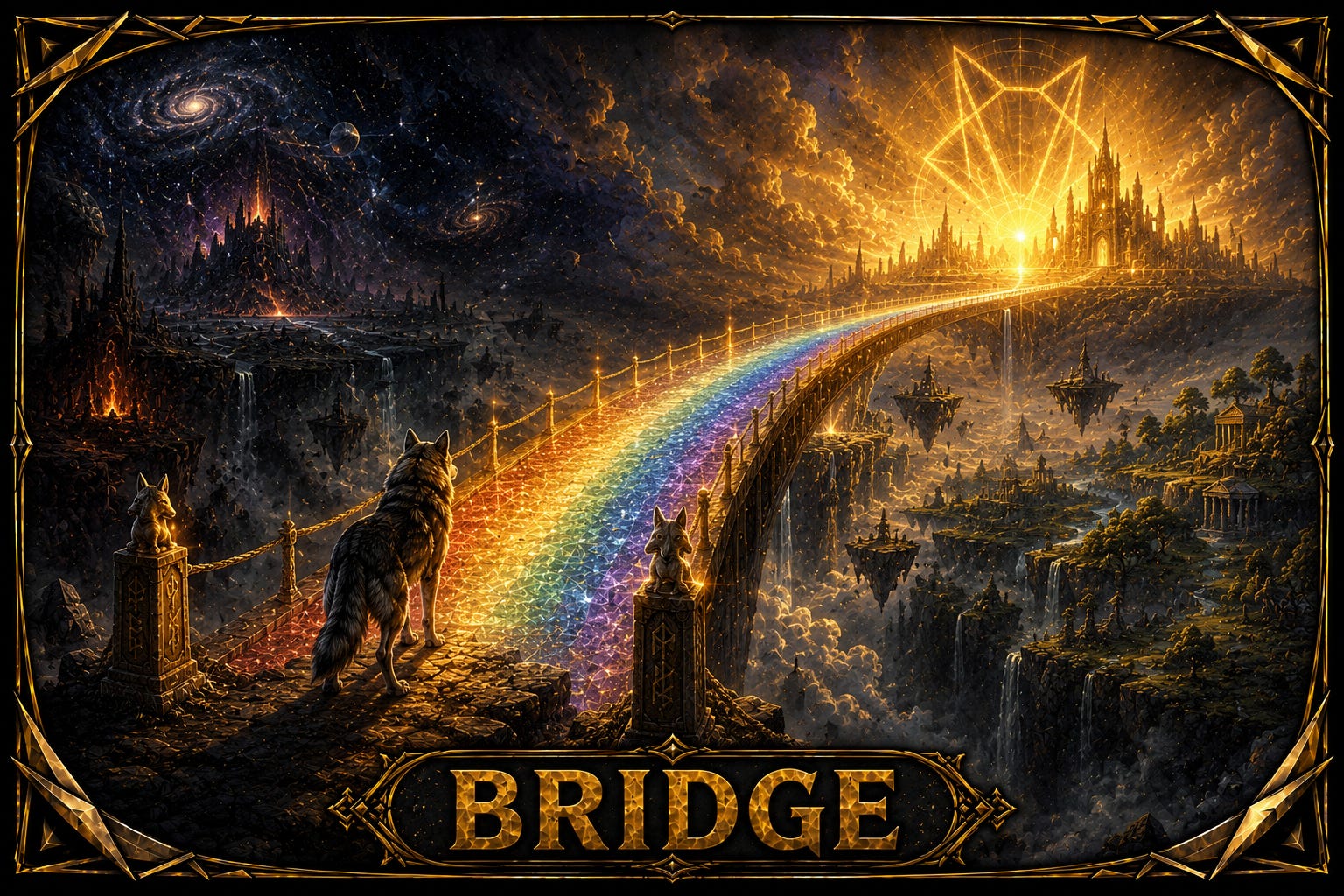
BRIDGE
The ancient archetype of the bridge, and what it means to the human experience

Welcome to Wolf Rehab. We are in the process of building a field guide for the human experience, investigating the terrain we call life, developing a method to traverse it, and building bridges that enable us to cross thresholds into higher levels of awareness and transformation.
Bridges appear in myths and stories across nearly every culture on earth, which suggests they touch something deep in the human psyche. Before they became everyday engineering structures, they existed in our imagination as liminal places. They are thresholds between worlds. A bridge is not just a crossing, it is the moment between what was, and what will be. Suspended above danger, above chaos, and above the unknown, it becomes a place where identity itself is tested. In mythology and folklore, the bridge is rarely neutral terrain. It is a passage that often requires risk, and a transformation waiting to happen.
I didn’t know any of that as a child growing up in north Georgia, but I felt it.
We lived on 36 acres surrounded by fields and forest in the Appalachian foothills. It was the kind of place where the boundary between imagination and reality never felt fixed. Deep in the woods behind our old farmhouse, a creek carved its way through the land. Its banks were steep, and crossing to the other side was never simple. Most attempts ended with mud on my knees, scrapes on my hands, and shoes soaked from misjudged steps on slippery roots. The crossing always seemed out of reach, as if the other side belonged to a different world.
Then one day, after a heavy thunderstorm, everything changed.
I walked out to the creek expecting the usual— shifted sandbanks, new bends in the current, fresh terrain to explore for G.I.Joe battles and catching crawdads. But instead, I found something else. A large oak tree had fallen clean across the water, its foundation torn from the earth leaving a crater in the dirt and a plume of roots above. The trunk stretched from one bank to the other. A bridge had appeared where there hadn’t been one before. It felt like it was always meant to be there. Two hundred years waiting for its true purpose, and in one violent night it found it.
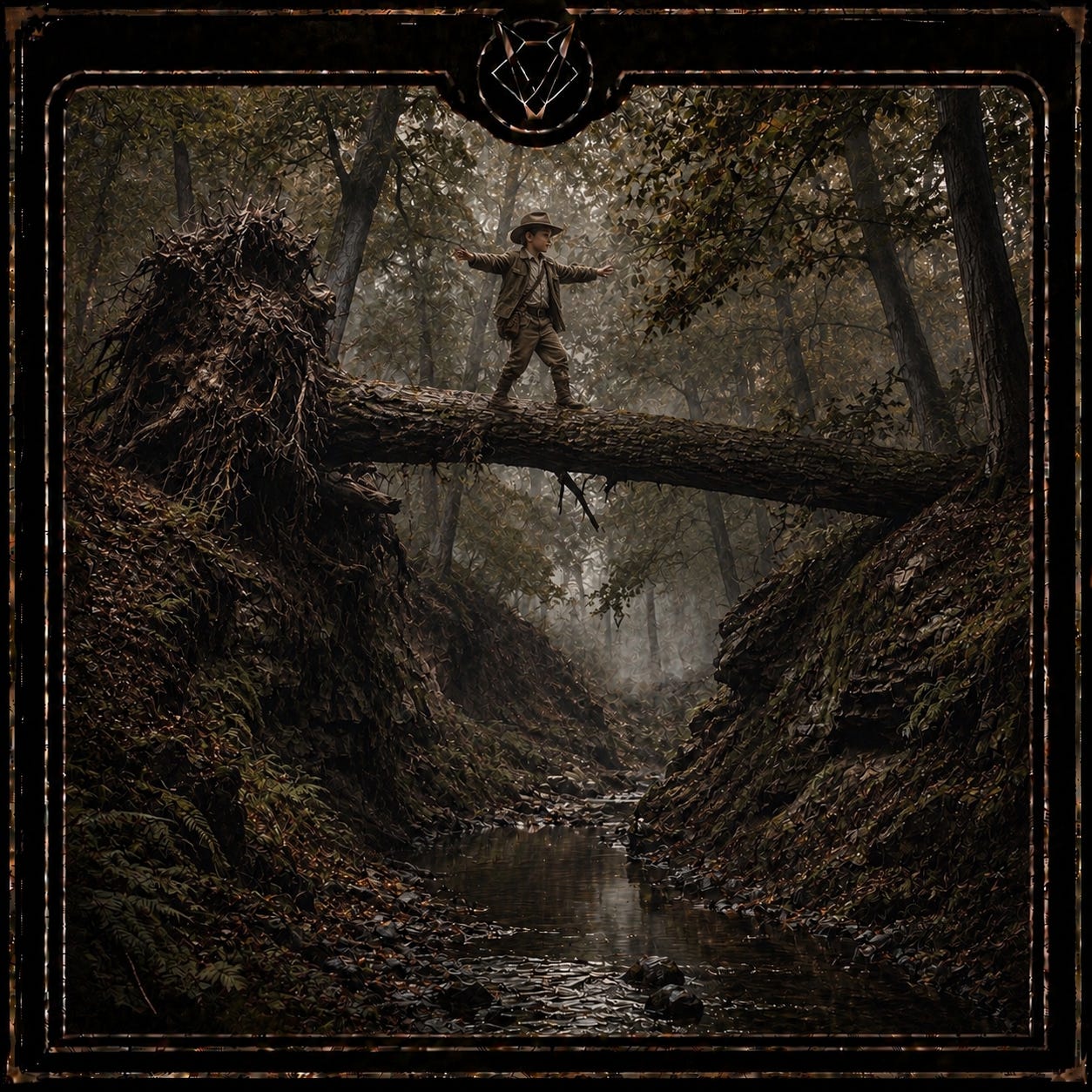
Suddenly, the crossing that once demanded struggle became possible. The other side was no longer something to imagine, it was something I could step into. That fallen tree became more than a path. It was a boundary line for games, a defensive post against invading sisters, a place to lie face-down and stare at the skimming dragon flies moving on top of the water’s surface. The storm had come, the landscape had shifted, and in its wake, a new world had opened.
Looking back, it’s hard not to recognize the pattern.
The image of the bridge appears so consistently in mythology that it begins to feel less like coincidence and more like a universal language. Cultures separated by oceans and millennia imagined the same thing: a narrow passage suspended above danger, connecting one realm to another. Whether between heaven and earth, life and death, ignorance and awakening, or childhood and maturity, the bridge becomes the place where transformation occurs.
And the one who steps onto it is never quite the same.
It is useful to understand how other cultures have grappled with the idea of crossing thresholds. Most people in the ancient world, being illiterate, composed elaborate stories to capture the moment when awareness transforms the individual. It seems that one’s imagination shares access to a realm of consciousness from where these stories originate. Myths, including the bridge archetype, may differ in culture and language yet have strikingly similar themes. When we look at the deeper layers, beyond the superficial telling of the story, a psychological and spiritual pathway opens that we all can travel.
In Norse mythology, and perhaps the most famous mythic bridge, is Bifröst. It is known as the “Rainbow Bridge” that connects the realm of humans, Midgard, with the divine realm of Asgard. This bridge was featured in the recent Marvel movies such as the Thor trilogy, the Avengers films, and related Asgardian scenes. Bifröst is guarded by the god Heimdall, whose senses are so sharp that he can listen to grass growing, and hear the wool on a sheep’s back move. He can also see across the nine realms, and controls who can enter Asgard. Heimdall is the archetypal bridge guardian. His role is to guard the entry by discerning one’s worthiness.
In mythic language, the guardian of the bridge is a psychological filter. One cannot simply wander into the realm of the gods. Something within must be prepared. Bifröst itself is described as fragile. During Ragnarök, the final cosmic battle, the bridge shatters under the weight of invading forces. The symbolism suggests that the bridge between worlds exists only so long as cosmic order remains intact.
In Zoroastrian mythology we encounter another bridge of profound importance. It is called the Chinvat Bridge, and sometimes translated as the “Bridge of Judgment.” This bridge is encountered by the soul after death. For the righteous it widens and becomes easy to cross, leading into the realm of light. For the wicked it narrows to the width of a blade and the soul falls into darkness below. The bridge here becomes a moral metaphor. It reflects the structure of one’s life. The crossing reveals who you have become. The bridge is not judging you as much as it is mirroring you.
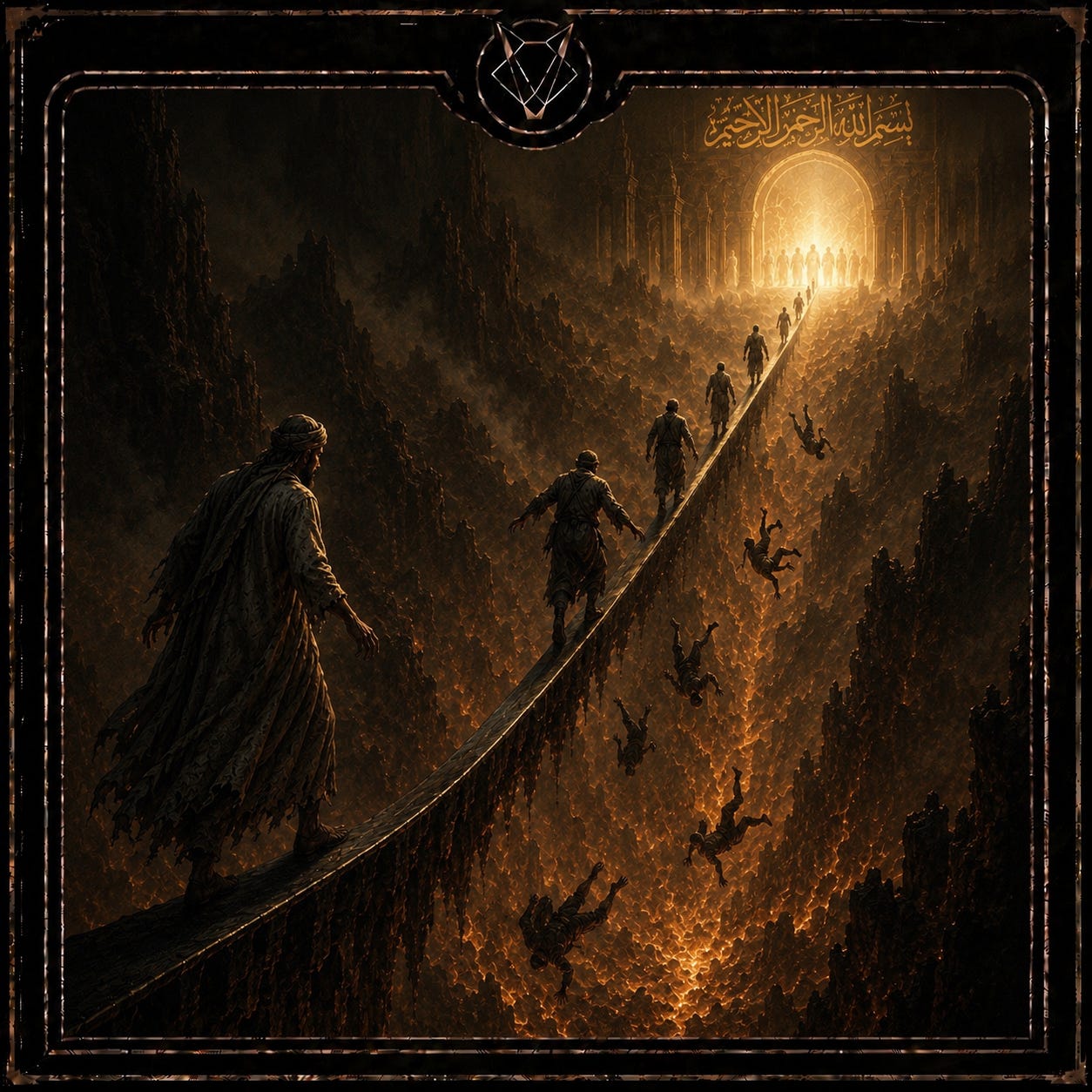
Islamic tradition echoes this same imagery with the Sirat Bridge, stretched over the fires of hell. It is said to be thinner than a hair and sharper than a sword. The righteous cross swiftly, some like lightning, others like a running horse. Others stumble and fall. The bridge is a distillation of the human journey. The crossing is the culmination of one’s inner alignment.
A recurring feature is the bridge’s narrowness. Mythic bridges are rarely wide roads. They are fragile structures; thin, precarious, or temporary. This detail communicates something essential about transformation. A wide road allows crowds to travel without thought. We see this today, illustrated by the majority of people distracted, scrolling on their phones, and unaware of their true potential.
In the Gospel of Matthew, when Jesus is preaching his Sermon on the Mount, he speaks about this broad path leading to a wide gate; many enter, many perish. A gate in mythology usually has the same meaning as a bridge. It is a transition point. Jesus then points out the narrow path that few find, and the narrow gate leading to life that few enter. A narrow bridge demands attention. The traveler must place each step deliberately. There is no room for distraction.
In Japanese Zen teachings, there is an old metaphor of crossing a single log bridge across a rushing stream. The student must focus completely. If the mind wanders, balance is lost. The crossing becomes an act of awareness. This story reminds me of the large oak tree that fell on our property. I would transit with arms wide, gaze steady, and feet placed one-by-one in tandem. It felt like Zen every time I crossed that creek bank.
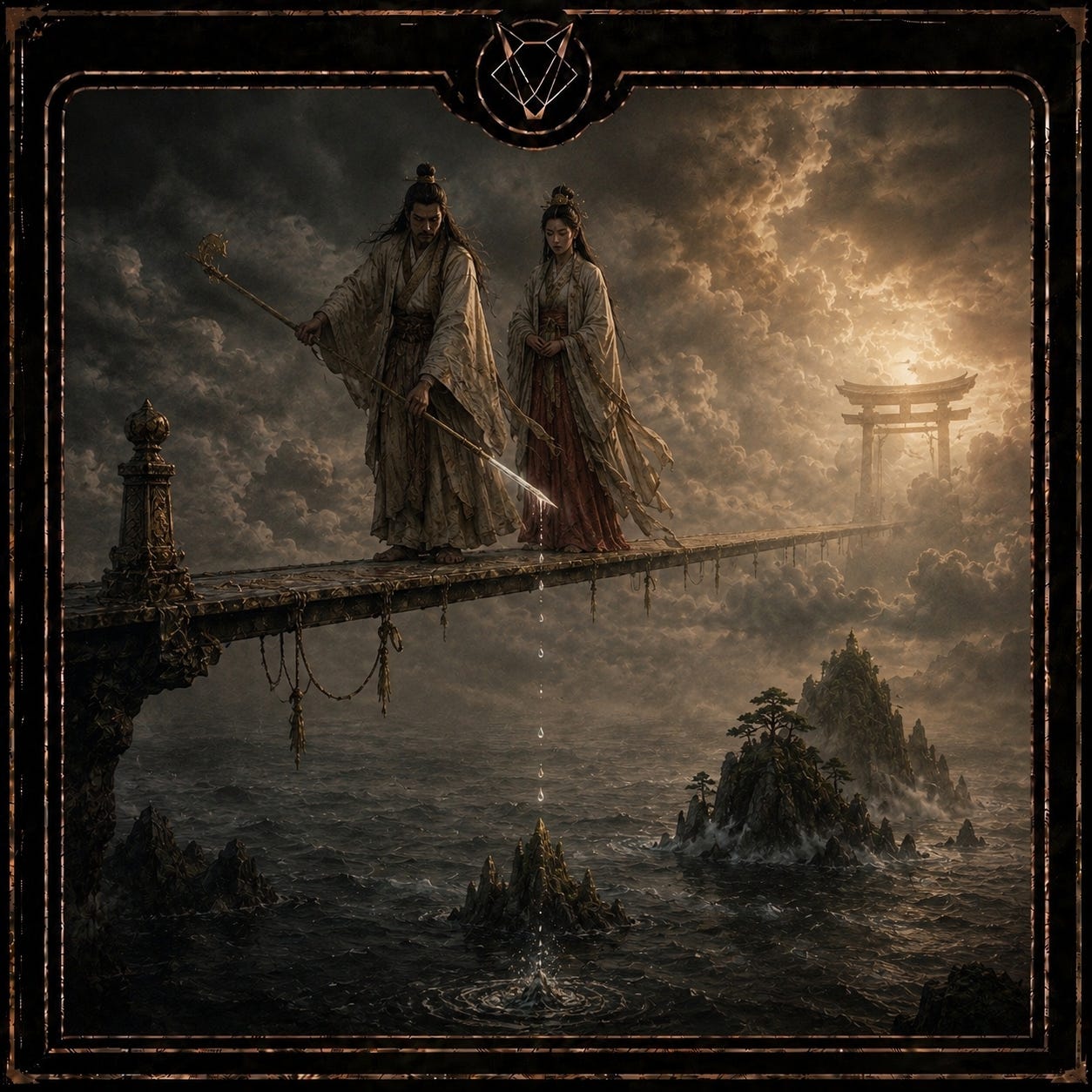
In Japanese Shinto belief we find the Ama-no-ukihashi, the Floating Bridge of Heaven. In the creation myth, the gods Izanagi and Izanami stand upon this celestial bridge and stir the primordial ocean below with a jeweled spear. Drops fall from the spear and become the islands of Japan. Here the bridge is not about judgment but creation. It is the vantage point between heaven and the raw waters of chaos. From the bridge, worlds are formed. Psychologically this makes sense. It is the realm of heaven where creative insight in formed. And we reach down into the turbulent potential to bring about our creations.
Another striking example emerges in the mythology of ancient Mesoamerica. Among the Aztec and other Nahua traditions, the soul’s journey after death involves crossing a treacherous river called Apanohuaya within the underworld realm of Mictlán. The dead cannot cross this river alone. They must be assisted by a dog, often described as a yellow or red Xoloitzcuintli. The dog guides the soul across the waters, carrying it safely to the other side.
Here again we encounter familiar elements. There is the river, representing the boundary between states of existence. There is the crossing. And there is the guide or guardian figure who assists or tests the traveler. Without the guide, the crossing cannot be completed. The dog in the Aztec myth mirrors many other mythologies where it’s the wolf that sits at the edge of reality. It paces the border of the forest, of chaos, or the unknown. They are the watchers that test the traveler.
In Celtic mythology, the crossing between worlds appears in more subtle forms, often described not as a constructed bridge but as a narrow threshold between the land of humans and the Otherworld. Celtic lore frequently speaks of mist-covered rivers, enchanted causeways, or thin paths that appear only at certain times. The Otherworld, known as Tír na nÓg or the Land of Eternal Youth, is not reached by ordinary travel. It requires crossing into a liminal zone where the boundaries of reality become thin. Sometimes this passage appears as a bridge of mist or a narrow stone path across water. More often, it is a ford across a river where the hero must step carefully between stones.
In Irish tales, heroes like Cú Chulainn often encounter such crossings. At these places they face tests, riddles, or combat before entering the next phase of their journey. The Celtic worldview held that rivers themselves were boundaries between worlds. The crossing point, the ford or bridge, became the place where destiny reveals itself. One might imagine standing at such a ford at twilight, knowing that the water flowing beneath carries both memory and possibility. Step wrong, and you are swept away. Step carefully, and you enter another realm entirely.
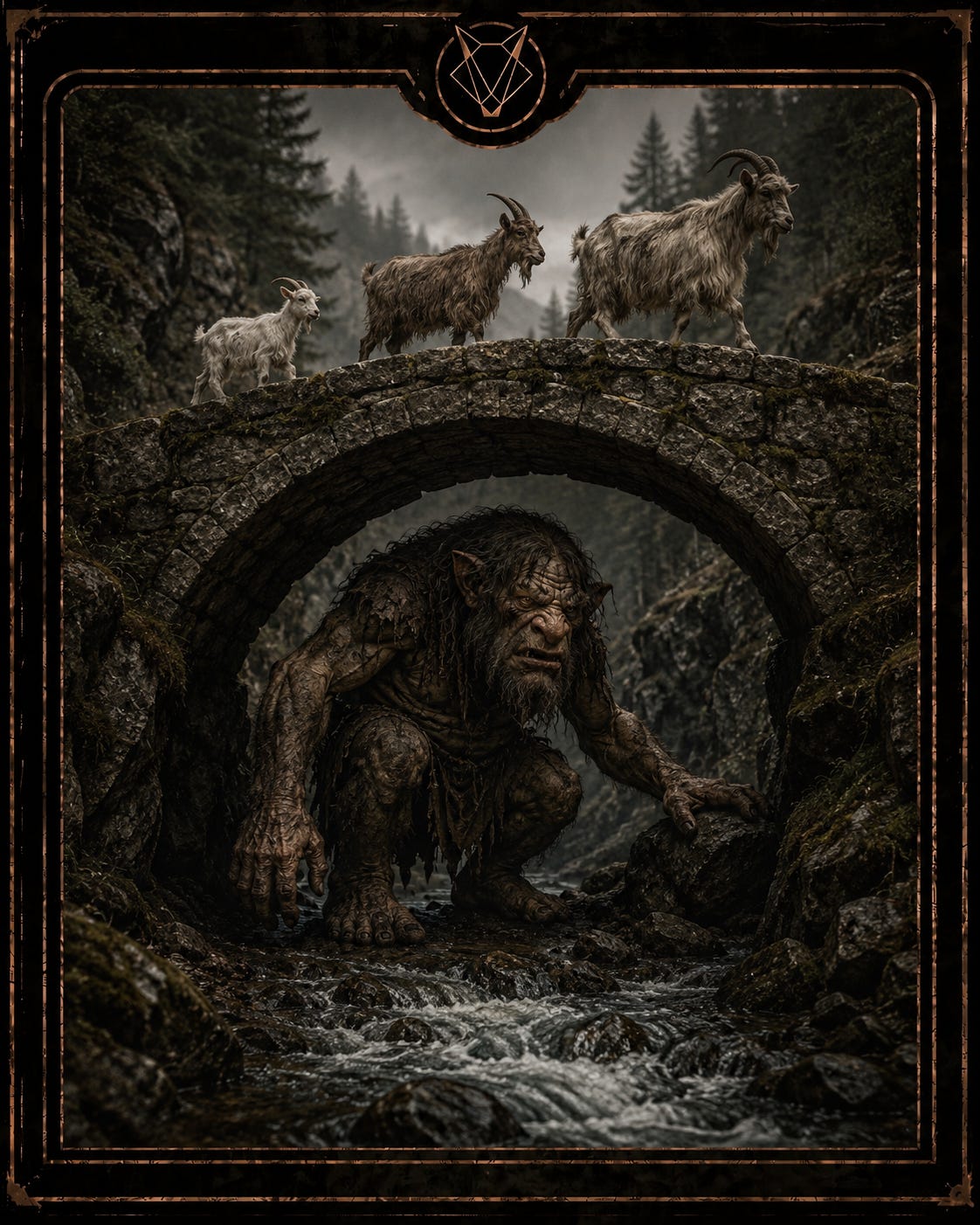
Folklore across Europe often places a darker figure beneath the bridge. The Troll. The most famous version appears in the Norwegian tale The Three Billy Goats Gruff. The troll lurks beneath the bridge, demanding payment from anyone who tries to cross. At first glance this may seem like a simple children’s story, but psychologically it reveals something deeper. The troll represents the shadow; the primitive, instinctual forces that live beneath the crossing point of transformation. When one approaches a threshold in life, the shadow appears. It asks for payment. Sometimes that payment is courage. Sometimes it is sacrifice. Sometimes it is the relinquishing of one’s old identity.
In Greek mythology, the dead must cross the river Styx aboard the boat of the ferryman Charon. Though this crossing is by boat rather than bridge, the symbolism remains identical. One must pay the ferryman, placing a coin in the mouth of the deceased before burial. Without this offering, the soul wanders the shore indefinitely. The idea of payment at the crossing echoes the troll beneath the bridge.
These guardians appear again in Tibetan Buddhism in descriptions of the Bardo, the intermediate state between death and rebirth. During this phase, the soul encounters terrifying or radiant beings that reflect its own mind. Though not always depicted as a literal bridge, the imagery of crossing through frightening thresholds remains consistent. The soul must move through visions that arise from its own consciousness. If fear overwhelms the traveler, the crossing fails.
Other cultures place serpents or crocodiles beneath the bridge. In ancient Egyptian mythology, the crocodile-headed god Sobek symbolizes the dangerous waters of the Nile and the unpredictable forces beneath civilization’s order. The creature beneath the bridge represents the abyss itself. Beneath every transition lies chaos. The bridge exists precisely because the terrain below is impassable.
What, then, does the abyss or water beneath the bridge represent? Across mythologies it consistently symbolizes the unconscious, chaos, or the unknown. Water especially represents primordial potential, or potential without form. In Genesis, creation begins with the spirit moving over the face of the deep. In Babylonian myth, the universe emerges from the waters of Tiamat, the chaotic ocean goddess. The same waters from which creation emerges from countless other traditions. To walk across a bridge above these waters is to move above the unconscious without being consumed by it. It is a controlled encounter with chaos. The bridge therefore represents structure emerging over chaos. It is the thin architecture of consciousness built above the unknown.
This imagery aligns strikingly with the structure of the hero’s journey described by mythologist Joseph Campbell. The hero always reaches a threshold. There is a moment where the familiar world ends and the unknown begins. The bridge is the physical embodiment of this threshold.
Fantasy literature and film repeatedly draw upon this archetype. In The Lord of the Rings, the bridge appears in one of the most iconic scenes in modern mythology. Within the mines of Moria, the Fellowship must cross the Bridge of Khazad-dûm, a narrow stone span over an abyss of darkness. As they attempt to cross, the Balrog, a demonic creature of shadow and flame, emerges from the depths. Gandalf confronts it with the famous declaration: “You shall not pass!” He breaks the bridge beneath the creature, sending it into the abyss, but in doing so he himself falls. The bridge collapses. This moment captures the symbolic power of the bridge perfectly. The crossing requires sacrifice. Something must fall away. In this case, Gandalf himself must descend into darkness before he can return transformed as Gandalf the White. The collapse of the bridge represents the irreversible nature of transformation. Once crossed, the old path disappears.
A similar moment appears in my favorite action movie from when I was a kid, Indiana Jones and the Temple of Doom. I remember my sisters and I watching the VHS cassette tape at home, and squealing with tension and nervous excitement as Indiana Jones fights the villains on the rope bridge over the crocodile-infested waters. Indy cuts the rope. The villain falls as the bridge collapses. The hero survives. The symbolism suggests that the bridge collapses because the hero must sever the possibility of retreat.
“A mind that is stretched by a new experience can never go back to its old dimensions.” - Oliver Wendell Holmes Sr.
This theme appears again and again across stories. In many myths, once the hero crosses the bridge, it is destroyed, burned, or disappears. The message is archetypal. Transformation is irreversible. Mythologies overwhelmingly teach us the former self cannot be reclaimed after crossing such a threshold. This reflects the irreversible nature of insight. Once a person truly sees something about themselves or the world, they cannot fully return to ignorance.
Once Odysseus leaves Troy, he can never reappear as the same man. He does return to Ithaca, but he has been reshaped by twenty years of trials. Once the Buddha leaves his palace and crosses into the world of suffering, he cannot return to living as a prince in ignorance. Once Moses crosses the Red Sea, the old life in Egypt is gone forever. The sea itself closes behind him like a collapsing bridge. Even Frodo, at the end of Lord of the Rings, returns to the Shire as a different version of himself. The physical and psychological trauma of his quest wouldn’t allow him comfort in the place of his youth. So he sailed with his companions on a white ship traveling the “Straight Road”; a mystical path that leads away from the physical world of Middle Earth to the Blessed Realm.
Crossing the bridge changes the traveler. Psychologically, the bridge represents the narrow passage between identities. Carl Jung might describe it as the moment when the ego encounters the deeper layers of the psyche. One stands between the known self and the emerging self. The bridge is narrow because identity cannot expand while carrying everything from the past. Something must be left behind.
Jesus even references this idea when speaking his parable about the rich man entering the kingdom of heaven. He uses the hyperbole of a camel entering through the eye of a needle. The camel symbolizes wealth: attachment, control, identity. The eye of the needle symbolizes the threshold of transformation, and requires something beyond ordinary effort.
This is why many bridges in myth are thin, fragile, or dangerous. The Chinvat Bridge narrows. The Sirat Bridge is razor thin. The bridge in Moria is a single stone path. These structures emphasize that transformation requires focus and discipline, while distraction and attachment to one’s old identity leads to falling.
And this is exactly why the guardians exist. They ensure the traveler is ready for what lies ahead. Sometimes they are gods like Heimdall. Sometimes they are monsters like trolls or dragons. They may use tactics of temptation and offerings to veer the traveler off course. Sometimes they are riddlers who demand answers before allowing passage, like the Sphinx in Greek mythology. Guardians exist because thresholds require tests. Without the test, the crossing would hold no meaning. The guardian is necessary because the quest is psychological. Human beings rarely grow unless confronted by resistance.
In the Bible, Satan fills the role of the guardian archetype when tempting Jesus in the desert. Following a forty day fast, a significant number in mythology, Satan tests Jesus to see if he will use his power to satisfy his flesh by turning stones into bread. He also tested Jesus to see if he would force God’s hand by jumping from the top of the temple. And lastly, Satan tempted Jesus with power over all the kingdoms, if only Jesus would worship Satan himself. The guardian is the embodiment of resistance, and often represents the ego, the flesh, or the false self. It is usually the constructed identity we hold in our mind, the subconscious, the shadow. And the hero must confront the fear, doubt, ignorance, or pride before moving forward. Jesus passes the test, and doesn’t fall for the ego’s temptations. He crosses the threshold and begins his ministry.
Another question worth asking is whether bridges only exist between life stages, or whether they also exist within everyday moments. Myth suggests the latter. Every decision point can function as a bridge. Every act of courage, every leap of faith, every abandonment of an old story about oneself can become a crossing. This may explain why bridges appear so frequently in dreams. Dream psychologists note that bridges often symbolize transitions in waking life; career changes, personal transformations, or spiritual awakenings. Each crossing leads to another threshold further ahead. The journey of becoming never truly ends.
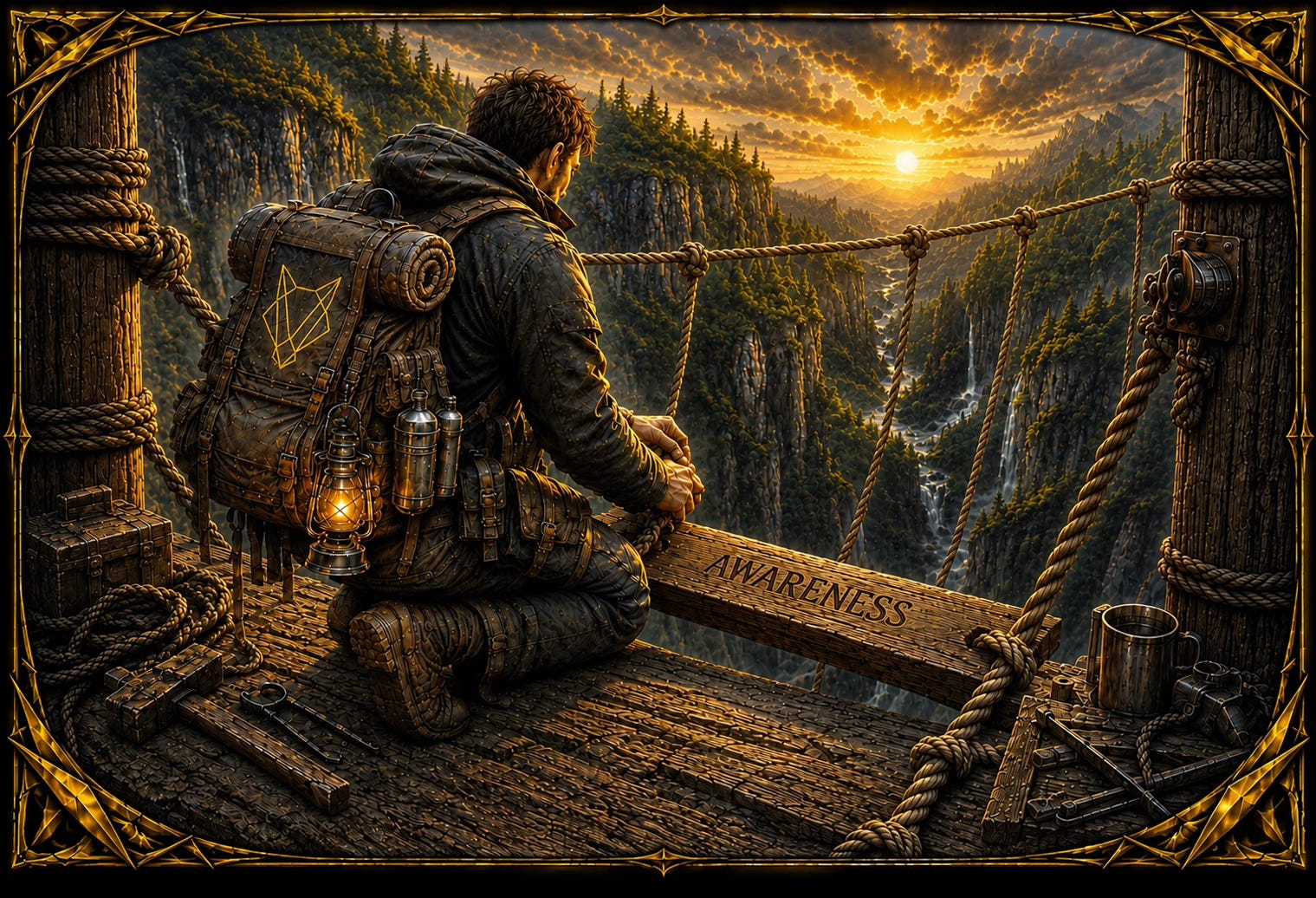
One final question lingers in the background of nearly every bridge myth: who built the bridge? Sometimes it is the gods. Sometimes it is ancient builders. Sometimes it appears mysteriously, as if it has always been there waiting. But another possibility emerges when we look closely at these stories. The bridge may not exist until the traveler begins to build it. Every act of awareness becomes another plank. Every confrontation with fear becomes another rope tied to the structure. Every insight becomes another step forward over the void. The bridge is something we must become capable of building.
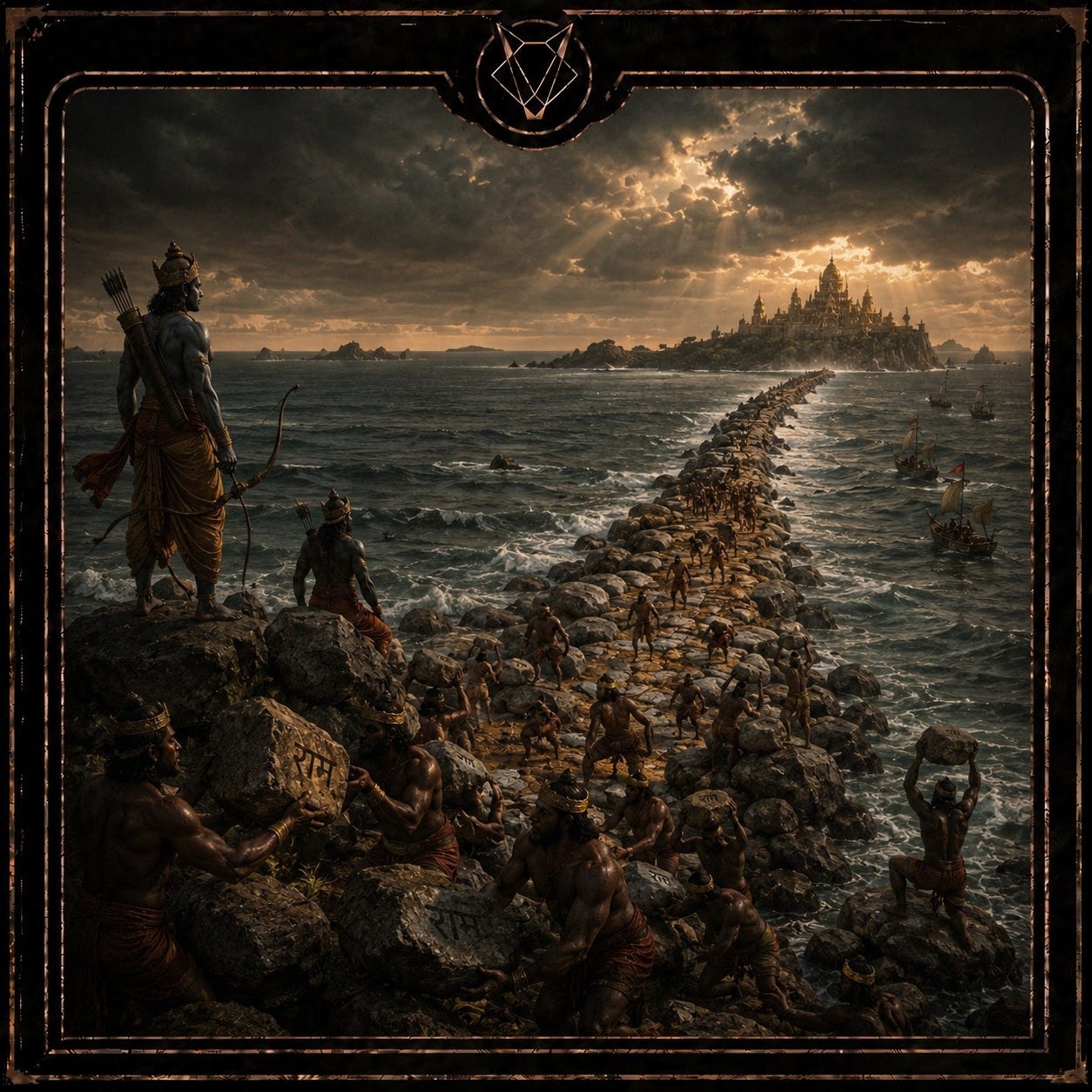
In Hindu mythology we encounter this bridge-building idea in the great epic Ramayana. When the hero Rama must reach the island kingdom of Lanka to rescue Sita, he faces an immense ocean that cannot be crossed. Rama is unable to rely on magical teleportation or divine intervention. Instead, he and his allies build a stone bridge across the sea, known as Rama Setu or Adam’s Bridge. According to the story, stones inscribed with Rama’s name float upon the water, forming a causeway between the mainland of India and Lanka.
The symbolism here seems obvious. The bridge is only crossed when it is built through devotion and collective effort. Every stone placed upon the water represents faith and alignment with a higher purpose. The abyss beneath is the vast ocean of chaos, yet the bridge holds because it is constructed through intention and unity. The hero does not simply find a bridge waiting for him. He creates it.
This idea resonates strongly within the Wolf Rehab philosophy. We must build a bridge of knowledge, discipline, and awareness where each insight and act of integration becomes a plank laid across the abyss of ignorance. To do so, we must also set aside the baggage we brought along on the journey. The bridge may not be able to hold it. The need for certainty, old belief systems, and insecurities may not survive the crossing.
The massive oak tree that fell across the creek bed when I was a boy still stands in my memory as the first map. It acts as a living metaphor for something ordinary that we usually overlook. Crossings are everywhere, but most people never recognize them. They stay on one side, imagining the other.
The work of Wolf Rehab is learning to see the bridge and step onto it, moving forward with our body, mind, and spirit aligned. Something in us will not survive the crossing, and something else will.
And that is the point.
The crossing is always dangerous because we are threatening our former constructed identities. The guardians always appear. The abyss does not disappear. The waters of chaos remain beneath the bridge. But we can learn to recognize the landscape, identify the crossing, and step out with increasing confidence.
If we compress the entire bridge archetype into one sentence, it is this: The bridge is the narrow passage where identity is tested above chaos, guarded by truth, and transformed into something that cannot return unchanged.
BRIDGING THE GAP
Looking back on your life, can you identify a moment when you felt called to leave behind a familiar way of thinking, living, or identifying yourself? What made that crossing necessary?
What fears, doubts, or attachments have made it difficult for you to move toward a new chapter, even when you sensed it was the right direction?
Who or what has served as a bridge in your life; a person, experience, book, hardship, or insight that helped you move from one stage of understanding to another?
If your life is a journey across a bridge, where do you feel you are standing today: at the threshold, in the middle of the crossing, or on the far side looking back? What tells you that?
Below is your BRIDGE Field Map:
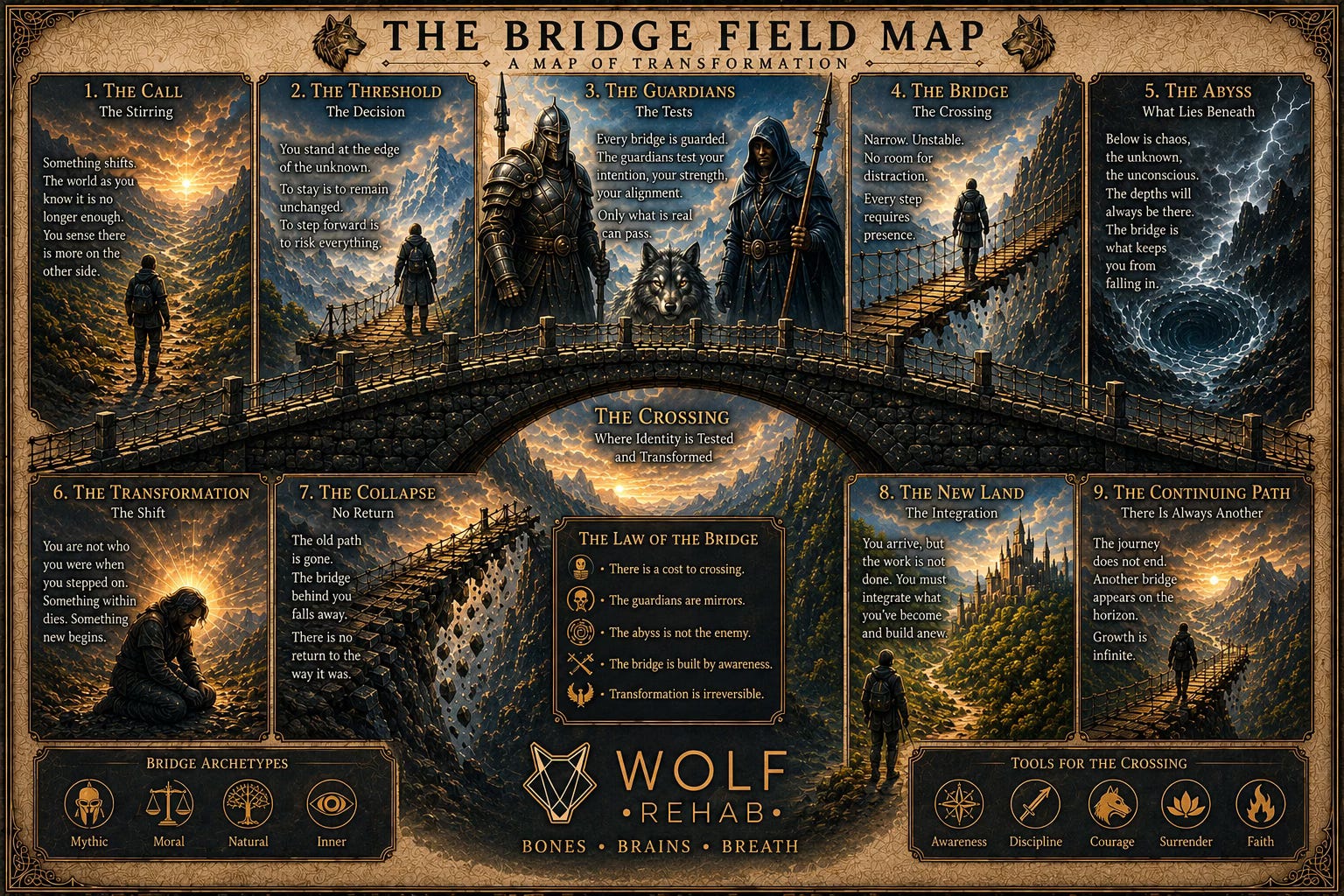
We have not yet explored how any of this is actually experienced. The landscape is not encountered directly. Everything we know about it is coming through a system that receives, filters, and organizes information before it ever reaches conscious awareness. That system is what we’re exploring next: The INTERFACE.
Wolf Rehab, LLC is a registered trademark. All rights reserved.
I like this metaphore as it recognizes that there’s legitimately something blocking your way but there’s always a way to get over it. I think I’m going to build on this one.