LANDSCAPE
Layers of reality, and how to navigate them

Welcome to Wolf Rehab. We are in the process of building a field guide for the human experience, investigating the terrain we call life, developing a method to traverse it, and building bridges that enable us to cross thresholds into higher levels of awareness and transformation.
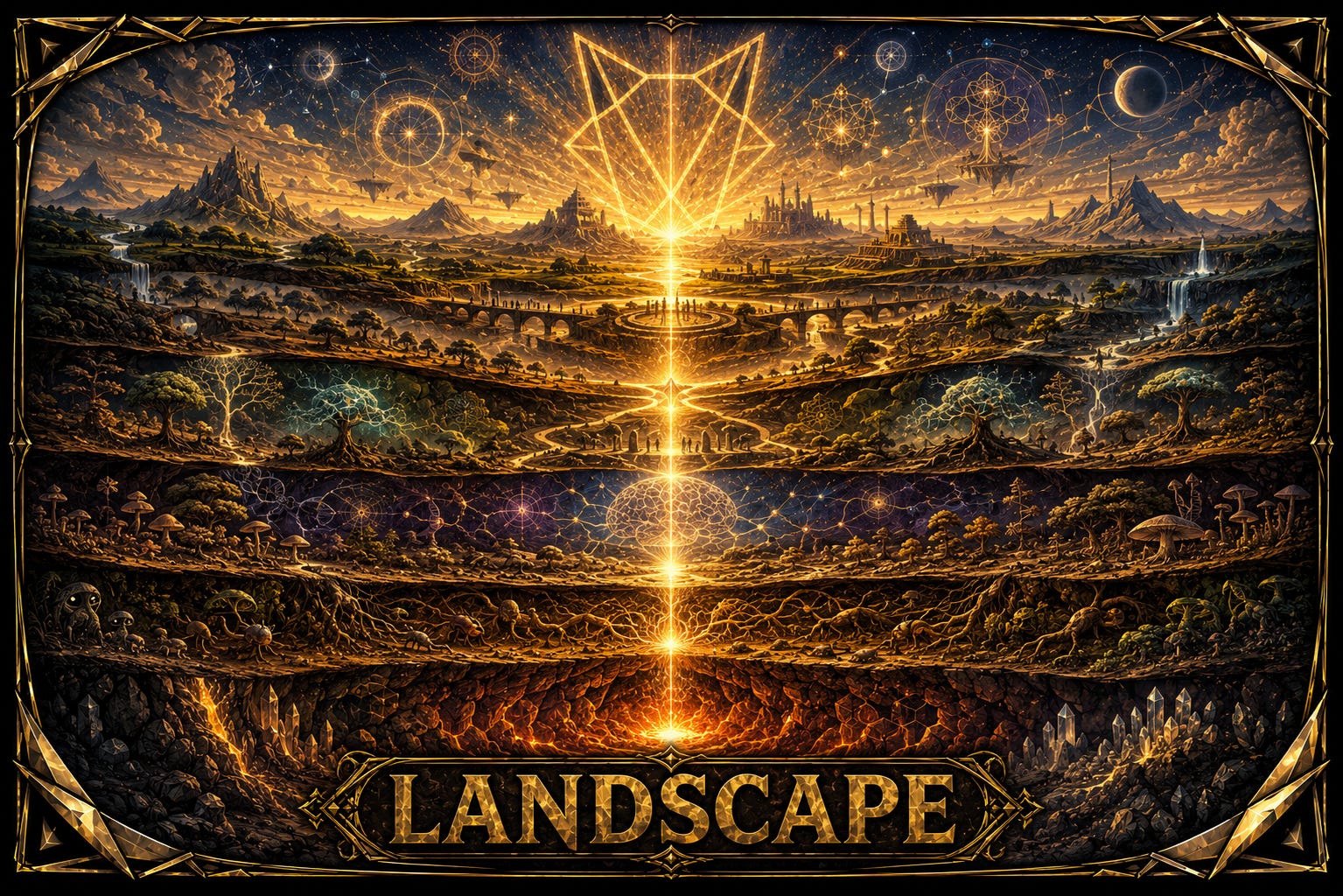
In the first chapter we communicated the need for a map, and a method, for navigating the landscape of life. But in order to achieve that aim, we need a framework of how reality functions, and how each layer interacts with our lived experience. So naturally, the next question should be: What is reality?
THEORY OF EVERYTHING
Many attempts have been made by scientists to nail down the physics of our world, as if a single equation could explain the layered complexity. These attempts are known as a “theory of everything.” But most attempts fail because they reduce everything to one layer. Physics is reduced to materialism. It is a doctrine who’s focus ranges from quarks to galaxies. In other areas of science, such as Psychology, the tendency is to reduce our mental experiences down to brain states. We see this too in religion, where belief systems often devolve into rigid and dogmatic theologies. Each structure operates in their own silo, seemingly separate from one another.
Rather than come up with my own theory of everything, I instead want to point out observations that the oldest and deepest traditions have also shared. Reality appears to be something stratified, recursive, and participatory. What we find is that the question of reality isn’t as simple as asking, “What is it?” A better question is, “Through what lenses must reality be understood so that nothing essential is excluded?” We can think of these lenses as domains that overlap. They bleed into each other. They are dimensions of the same field, and describe the same world from different vantage points.
So instead of trying to compress reality into a single explanation, it may be more accurate to think of it as a layered landscape. We can picture a kind of topographical map. Not a flat diagram, but a terrain. And like any terrain, we don’t navigate it by memorizing one rule, or one theology. Belief systems, whether religious or scientific, can be useful. But they often lock a person into a limited understanding of one terrain. That would be like me, standing in the Sonoran desert, attempting to tell a person in the arctic circle what reality looks like. Instead, we navigate life by understanding where we are, what layer we’re standing in, and what kind of movement is possible from there. The whole point of this venture is to help myself and others build their own maps, so that we can better orient ourselves with the complexity of life.
LAYERS OF REALITY
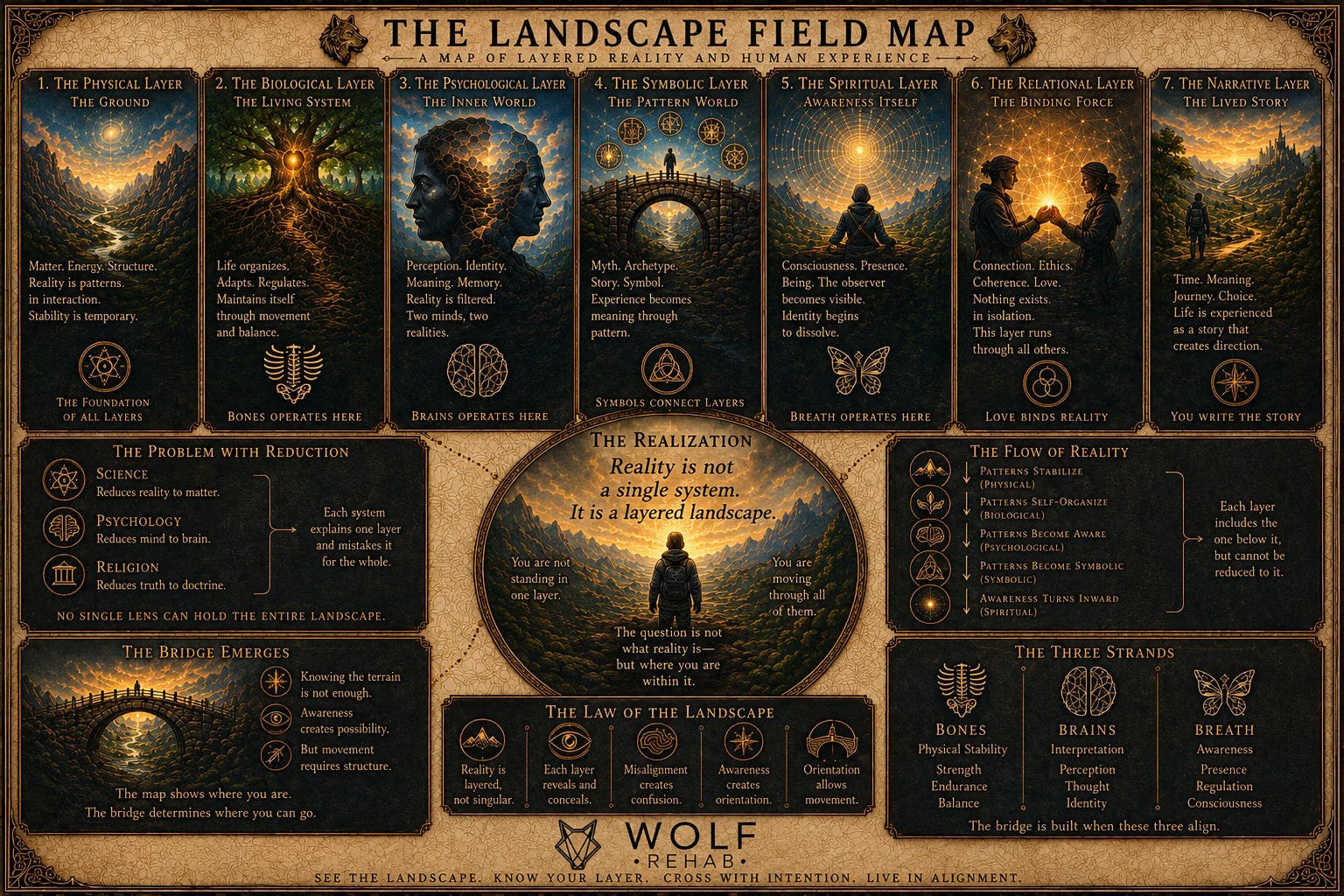
At the most fundamental level, you have the physical layer; the world of matter, energy, space, and time. This is where most theories begin. But even here, the ground is less solid than it appears. What we call matter dissolves under close inspection into probabilities and interactions. At the level explored by quantum mechanics, reality behaves less like a collection of objects and more like a network of relationships. Things do not present like “things” but more like patterns that hold together long enough to be recognized. The body, the ground beneath your feet, and the structures you rely on are all stabilized patterns.
Then something shifts. At a certain level of complexity, patterns don’t just persist, they begin to organize themselves. This is the jump that physics has never been able to fully explain within a linear model. This is the biological layer that is dependent on the physical, but lies above it. As life emerges, systems adapt, regulate, and find balance as they maintain themselves. One of the distinguishing features is movement. A rock remains what it is. A living system actively works to remain what it is through the constant process of homeostasis. It learns, senses, and replicates. And then it dies, releasing its physical contents back to the layer below.
This is where the Wolf Rehab domain we are calling “BONES” lives. It is the layer of reality that represents the body with its adaptive structure, integrity, and its ability to hold its shape against the pull of chaos. It requires strength, endurance, flexibility, and balance. These are not static qualities, but responses to an ever-changing environment. Life, in this sense, is already a kind of bridge. It is the ongoing movement from disorder into temporary order, again and again.
But the terrain shifts again when experience enters the picture. With the emergence of mind, reality becomes internal as well as external. The psychological layer introduces perception, memory, identity, and meaning. The world is no longer just what is “out there.” It is what is interpreted. Two people can stand in the same environment and live in entirely different realities because of how they perceive it.
This is the Wolf Rehab domain of “BRAINS”. Here, the bridge is no longer something one crosses physically. It is something crossed internally. Old identities dissolve. New ones form. Fear acts as a survival mechanism, but often a barrier. Awareness acts as a pathway. One begins to realize that much of what we call “reality” is filtered through the structure of our own mind.
This insight is not new. The psychologist Carl Jung pointed toward this when he described archetypes as recurring structures of the human psyche. They are psychological patterns that repeat across cultures because they reflect something built into the way we experience the world. And when we step back, we begin to see that these patterns don’t just live in the mind, they extend into story.
People have consistently organized their experiences into symbols and myths no matter the culture or time. This is the symbolic or mythic layer. It’s where the archetype of the bridge shows up not as a literal structure, but as a recurring pattern: the crossing, the abyss, the guardian, the transformation on the other side. Myths are often misrepresented as primitive attempts at science. But this is not the case at all. They are compressed maps of human experience. They take something internal and give it form. They allow what is difficult to articulate to be seen and shared in a story format.
This aligns with what Joseph Campbell described as the recurring structure of transformation found in stories across the world. The hero leaves the familiar, encounters resistance, crosses a threshold, and returns changed. The details vary, but the pattern holds. The bridge is used as both a metaphor and a universal structure embedded in the human psyche. It is how we understand change.
We wear symbols like decorations of reality. But instead we can think of them as interfaces between layers. They are like wormholes that can translate biology into meaning. A symbol can turn psychology into a story and direct one’s experience. They allow movement between domains that would otherwise remain disconnected.
If we keep moving through the terrain, we arrive at a layer that is harder to define but difficult to ignore; the spiritual or metaphysical layer. This is where attention turns toward awareness itself. It is not just what you experience, but the fact that you are experiencing at all. Different traditions use different language here, but they point toward something similar. It is a recognition that the self we identify with may not be the deepest level of what we are.
In this layer, the bridge changes again. It is no longer about changing one’s identity. It is about seeing through what we thought we were. The crossing is not from one place to another, but from misidentification to clarity. The Wolf Rehab domain of “BREATH” fits here. In its many traditional forms, breath is used to symbolically represent the infusion of Spirit. It is presence, or the subtle awareness that sits beneath thought, identity, and the constant movement of the mind. To breathe is to maintain contact with consciousness. And to breathe intentionally is to realign with Spirit and see past the illusion of the constructed self.
Running through all of these layers is something that often gets treated as secondary, but may actually be foundational. Relationship. Nothing exists in isolation. Not particles, not organisms, not thoughts, not people. Everything is defined, at least in part, by how it relates to something else. From this perspective, what we call ethics are not just moral preferences. Love, truth, cooperation, and honesty are stabilizing forces. They are what allow systems to hold together rather than fracture. Fear isolates. Love binds. And each carries an energy or frequency that you can feel. It shows up at every level, from biology to human relationships.
And then there is the way all of this is experienced. We create a story. No one wakes up thinking in terms of layers of reality. We wake up inside a narrative. There is a past, a present, and a sense of where things might be going. There are challenges, decisions, consequences, and moments of transformation. The idea of a “soul journey” fits here. Again, this is not a literal doctrine, but a structural truth. Humans understand their lives through movement and change. We narrate the thresholds we cross, and the moments where something ends and something else begins.
When we step back and look at all of this together, reality starts to look less like a single system and more like a field of interwoven processes. Patterns stabilize (physical), then self-organize (biological), then become aware (psychological), then interpret themselves (symbolic), then question their own nature (spiritual). Relationships either stabilize or fracture (ethical). And all of it is happening at once while experienced as a story (narrative).
If the layered landscape is what reality is, then the next question is: How do we move through it? How do we navigate it in a way that is not random, reactive, or fragmented? This is where the Wolf Rehab BRIDGE series begins— as a method.
THE METHOD
It starts with a recognition that where we are and where we’re capable of being are not the same place. And that the distance between the two is not crossed all at once. It is crossed deliberately, one step at a time.
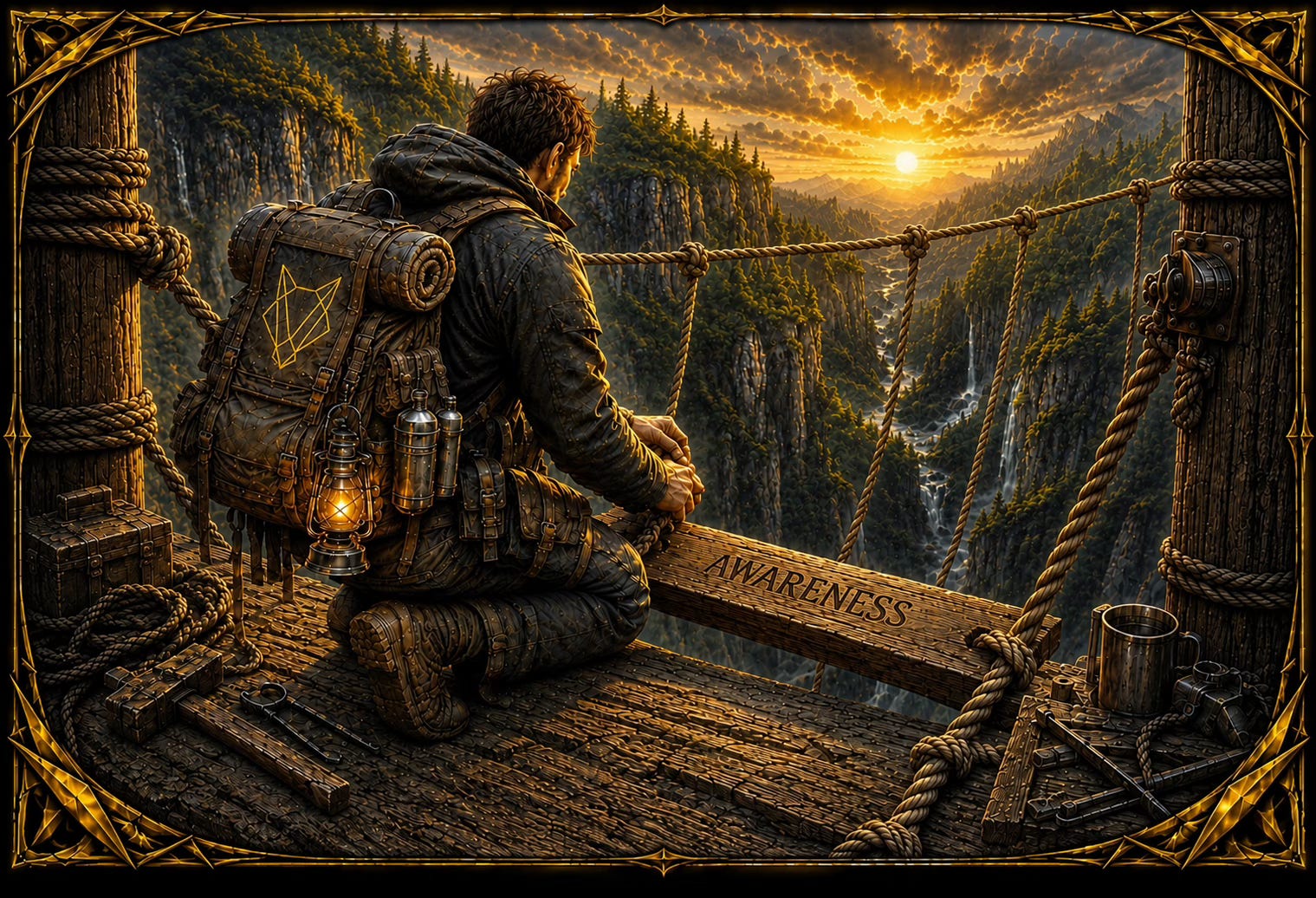
The central image is simple, but it carries the weight of everything we’ve just explored. The BRIDGE is illustrated as a rope bridge stretched across an abyss. This imagery works because it is not a permanent structure, and it’s not something handed to us fully built. It is something that must be constructed as we move. Each plank represents an insight, a skill, a realization. It is an awareness that we didn’t see before, and once seen, becomes part of the path forward. We don’t wait until the bridge is complete to begin crossing. The act of building and the act of crossing are the same thing.
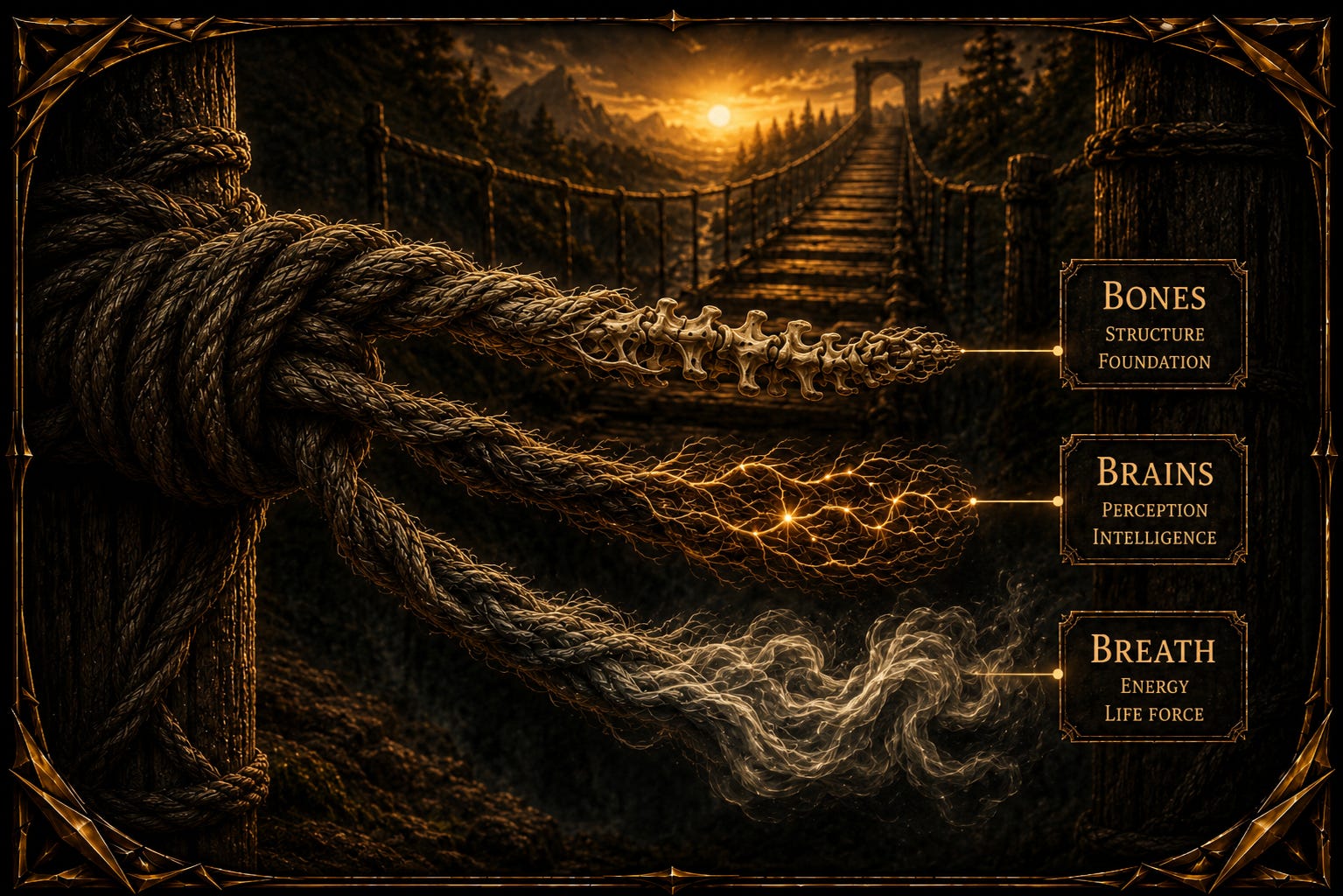
But a bridge is only as strong as what holds it together. The planks matter, but they don’t float in the air by themselves. They are suspended by the rope containing three intertwined strands. These strands are represented by the categories of BONES, BRAINS, and BREATH. Not separate systems, but interdependent ones. Each strand carries tension, and each strand distributes weight. If one weakens, the entire structure becomes unstable.
“Nobody can build the bridge on which you, and only you, must cross the river of life.” - Friedrich Nietzsche
BONES is the physical foundation. It is the body, but not just in the sense of anatomy. It is strength, endurance, flexibility, and balance. These are the qualities that allow us to remain grounded in the real world. Without this strand, everything becomes theoretical. We can have insight, but no ability to act on it. My patients tell me all the time, “My mind is willing, but my body betrays me.” We can understand what needs to change, but lack the stability to follow through. BONES is what keeps the bridge anchored to something real. It is our capacity to hold form under pressure.
BRAINS is the interpretive layer. It is how we think, how we perceive, and how we assign meaning to what happens. This is where most people get lost, because the mind doesn’t just observe reality, it filters it. It creates narratives, reinforces patterns, and defends identities. If this strand is rigid, the bridge becomes narrow and brittle. If it is chaotic, the bridge becomes unstable. What is required here is clarity and adaptability. It is the ability to see our own thinking without being trapped inside it, and to update our understanding as we move rather than clinging to outdated maps.
BREATH is the most subtle strand, but it may be the most important. As mentioned above, it is not just breathing, it is awareness, and presence. It is the part of us that can observe without immediately reacting. This is what creates space. Without it, everything collapses into impulse. We become reactive rather than intentional. BREATH is what allows us to step back, to widen our perspective, and to reconnect with something deeper than the immediate moment. It keeps the bridge from becoming mechanical. It brings life into the structure.
These three strands are not independent from one another, which is why they are integrated into the symbol of the rope. For instance, we can have strength, but without awareness it can turn into force. We can become aware of an issue, but without the structure to act we remain passive. And thought without grounding can turn into distortion, as we remain caught in analytical loops. But when BONES, BRAINS, and BREATH are aligned, something different happens. The bridge becomes stable without being rigid. It is flexible, but not weak. The bridge becomes responsive, but not prone to chaos. It can carry weight, adjust to movement, and hold under stress. It is resilient.
And as the bridge extends, something else becomes clear. The abyss below does not disappear. The uncertainty and the risk are still there. But our relationship to it changes. What once felt like something to avoid becomes something we can move over. The chasm that exists between what we were, and what we can become still exists. But now we have built the capacity to cross it.
There is also a point, if we keep going, where we notice that the bridge behind us is no longer accessible in the same way. The bridge hasn’t vanished, but we have changed. The version of us that stood at the beginning does not exist in the same form anymore. The patterns, the assumptions, the limitations no longer hold the same weight. This is why many stories of mythical bridges collapse behind the traveler. It is what transformation looks like. We cannot return to a previous level of awareness once it has been seen through.
SUMMARY
And this is where the map and the method come back together. Reality is layered. It is physical, biological, psychological, symbolic, and spiritual all at once. It is relational at every level. It is experienced as a story. And because of that, it cannot be reduced to a single explanation without losing something essential. But it can be navigated.
Wolf Rehab is presenting a practice of navigating it consciously. It is the decision to stop wandering the terrain blindly and begin constructing a path with intention. Not the whole path at once, and not a perfect path. Just the next section, next step, next plank.
The landscape does not stop changing. New terrain appears as life shifts and circumstances change. This brings the opportunity to overcome new challenges as they emerge. The teutonic plates in one’s life will push up from the depths, mountains will reveal themselves, and islands will surface. New layers of landscape will form, and new bridges must be built.
If this is a theory of everything, it is not one that gives us control over reality. It is one that gives us orientation within it so it can be traversed. It is a map, and a method. It is a bridge that is always being built beneath our feet.
BRIDGING THE GAP
Have you ever experienced a moment when something you had always taken for granted suddenly seemed strange, mysterious, or worthy of deeper examination?
How much of your understanding of reality comes from your own direct experience, and how much comes from ideas, stories, and explanations you inherited from others?
If two people an experience the same event yet walk away with completely different interpretations, what does that suggest about the relationship between perception and reality?
If you could step outside your current assumptions for a moment and view reality with fresh eyes, what is the first question you would want answered?
Here is your LANDSCAPE Field Map:
Next, we will explore how other cultures built bridges within their collective-consciousness. The symbolic archetype of the bridge holds great meaning, and to understand the depth of that meaning will help strengthen the foundation of what we are building.
Wolf Rehab, LLC is a registered trademark. All rights reserved.