
ORIGINS
Gaining perspective, and questioning my own.

Welcome to Wolf Rehab. We are in the process of building a field guide for the human experience, investigating the terrain we call life, developing a method to traverse it, and building bridges that enable us to cross thresholds into higher levels of awareness and transformation.
There is usually a time when many people start questioning their assumptions, and begin seeking new perspectives. Origins is a tale of my exposure to other’s lifelong experiences far outside my original frame of reference. My oldest patient was 107 years old and taught me about the Great Depression. Another was the granddaughter of a Civil War veteran, and she told me some of her grandfather’s accounts. They have all taught me so much, and exposed me to life experiences that continue adding to this framework. It has lead to this passion project.
STORY TIME
I was entering my third clinical rotation while in physical therapy school, and was assigned to a home health branch located in the foothills of the north Georgia mountains. My instructor was meeting me at the office, and I was excited to experience my first day in the field. That morning it had rained, so the fog came in under the pine trees with the damp air that causes everything to smell like mildew. I had previous experience working under the florescent lights of an outpatient clinic with treatment tables, exercise machines, and therapy modalities. Going to patient’s homes and experiencing their unique environments would prove to be both difficult, and rewarding beyond measure.
Our first appointment was with a patient who had fallen and broken her hip. She recently returned home from the hospital, and it was our job to get her moving again. The Garmin GPS tried its best to navigate, but gave up after the pavement turned to mud. We crept down the winding forrest road, puddles sloshing the tires, before arriving at what looked like an abandoned modular home. No house numbers, and no front door. My instructor gave me a confused look before putting the car in park and unbuckling her seatbelt.
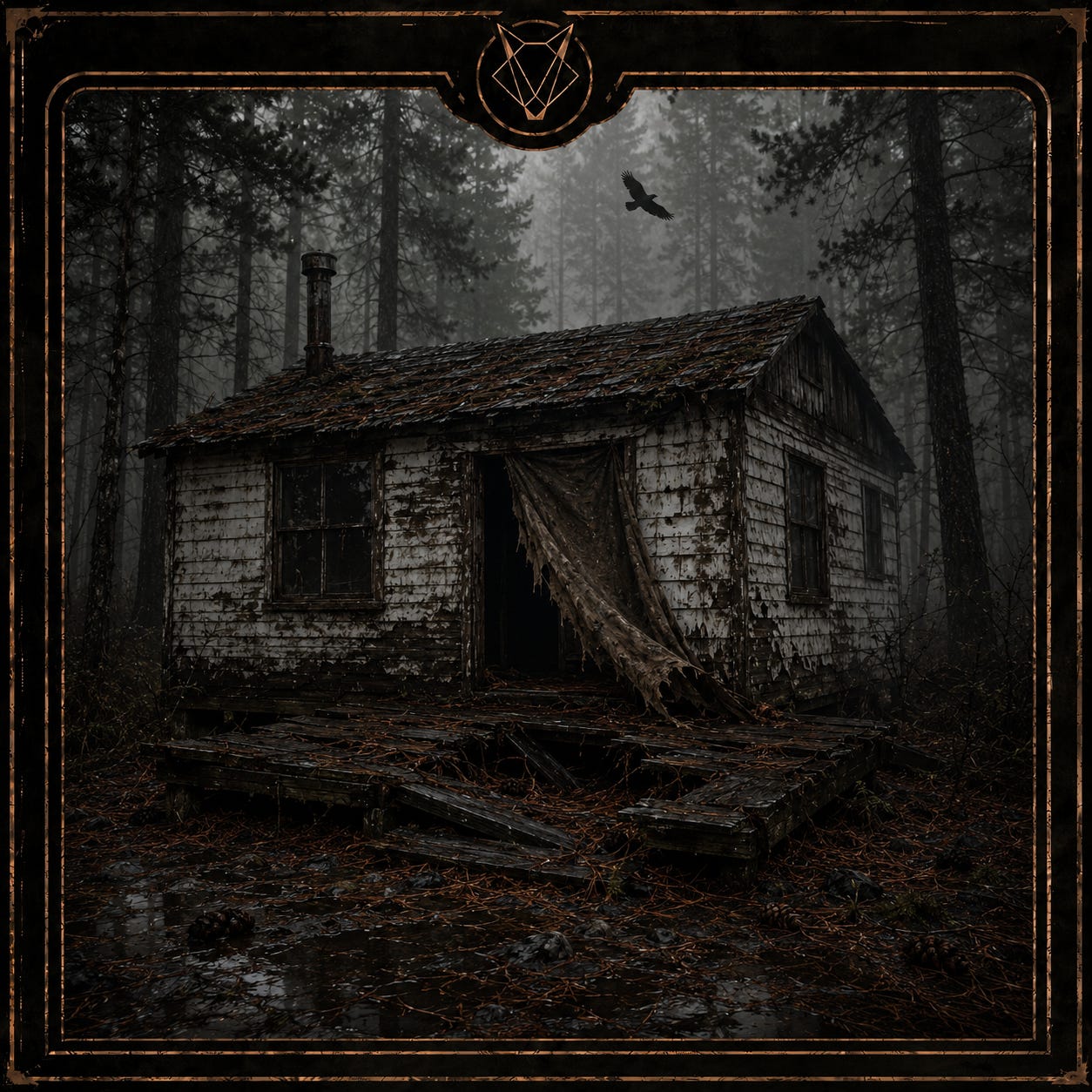
The silence was eerie, except for an occasional warning cry from a circling crow. The front porch was made from recycled railroad ties that nature had reclaimed. We carefully stepped around the perimeter to avoid the sunken crater in the middle, caused by termites and a lack of building codes. The only divider from the outside weather and the inside interior was a tattered blanket strung above the doorway, hanging on by a few staples. We called out to see if anyone was home. A faint voice in the middle of the trailer whispered for us to come in.
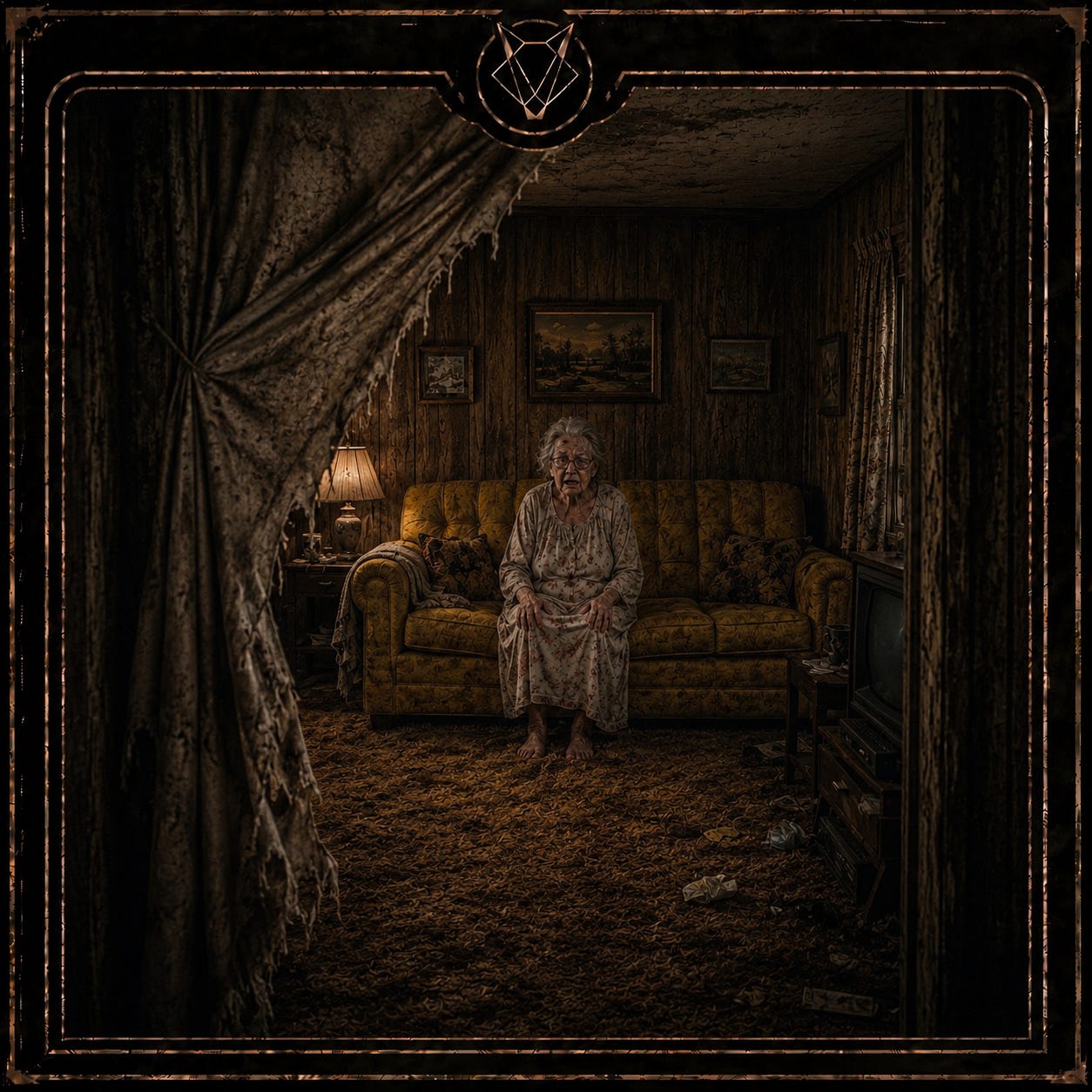
I parted the blanket, and a plume of sour cigarette smoke engulfed us both. An instant headache formed in my temple and shot to the base of my skull. Once inside, a dimly lit lamp was struggling to push back the darkness. Next to the lamp was our patient, sitting upright on a mustard yellow sofa that sat on top of brown shag carpeting. The trailer was a relic of the 1970’s with dingy wood paneling, linoleum floors, and a green kitchen sink.
The old lady was damp from the waist down and reeking of urine, a consequence of her inability to escape the sunken cushions. The yellow colored sofa masked the urine stains, but couldn’t hide the smell. The ambulance transport team placed her in that exact spot after her discharge, three days before we entered through the blanket barrier. She had wavy platinum gray hair, cigarette stained wrinkles, and an expression that told the story of a hard life.
After much struggle, we were able to get her up standing with white knuckles gripping the walker. We assessed her ability to walk, and she limped into the kitchen wincing with pain in every step. At the back of the kitchen, past the cracked and curling linoleum was another blanket tacked to the wall. As we approached, a grunting sound bellowed through. It was the kind of noise one makes when mimicking the giant in the fairy tale Jack and the Beanstalk. Deep. Husky. Authoritative. I glanced at my instructor—my facial expression signaling both alarm and amusement. We made a U-turn in the kitchen, thinking it best to return to the sofa and avoid the mystery room. But it was too late.
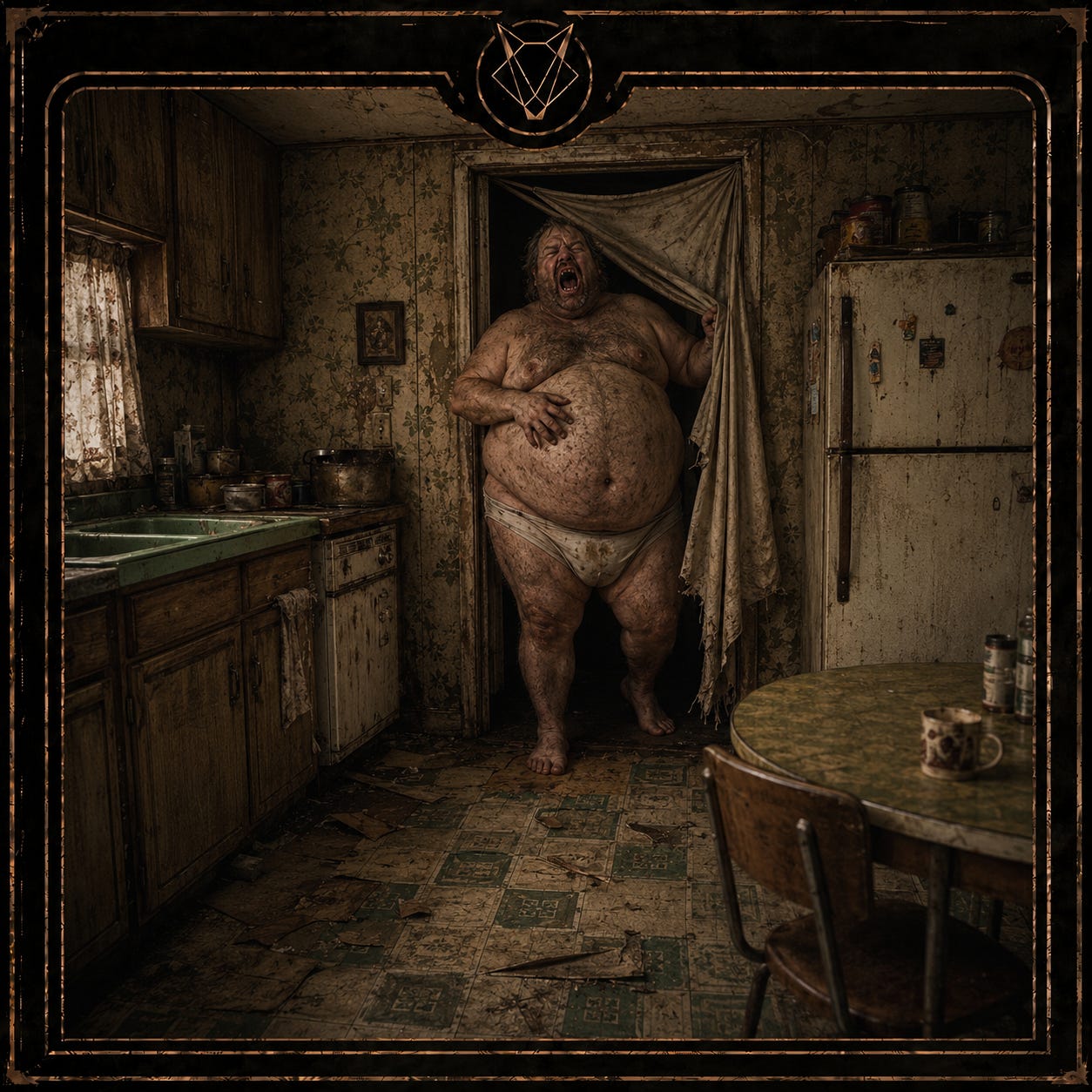
The second blanket was slapped to the side. In its wake stood a pale, white giant. The kind that’s made of Pillsbury rolls and fur. He was a four hundred pound product of limited gene pools. A forest dwelling Sasquatch who’s only choice of apparel was brown-streaked whitey tighties. Despite having strangers in his home, he didn’t seem to notice us. He instead pounded on his chest, yawned with mouth gaped, eyes closed, and scratched his belly fur with overgrown nails. He proceeded to shuffle to the refrigerator as the floor boards moaned.
It was at this time our patient turned to look at me with concern in her eyes. I looked at my instructor with concern in mine. We both grabbed hold of our little old lady, and attempted to meet all her therapy goals in one short walk back to the sofa. I looked back at the refrigerator. The man looked at me with one of his eyes. The other was scanning the contents of the fridge.
He looked to be middle aged, somewhere in his forties, and carried himself like the Bergens in the movie Trolls. A loud shout pierced the room. I twitched, startled but curious, wondering if there was a troll inside he was attempting to eat. There wasn’t. Instead, the beast yelled out in a flurry of emotions. Anger, sadness, frustration, and a sense of longing were all rolled into the most epic monologue I have ever witnessed in home health.
For the following description, one would have to picture the character Sloth from The Goonies. He was acting as the offended party, arguing his case in front of the court, with us acting as his jurors. The defendant was a miniature girlfriend that lived in the fridge. She was half the size of a bottle of Ketchup, and was being accused of infidelity. Allegedly, she insulted the walrus that stood before us by teasing him relentlessly, and then would hide in the back of the fridge behind the condiments. She would disappear for days, only to return under nefarious circumstances. She would apologize. They would make up. And then she would do it again. He finished his closing argument by turning to face the refrigerator shelf, screamed obscenities at her, and slammed the door shut. The accuser staggering towards our exit, stopped at a worn out recliner next to the doorway, and began humping the arm rest out of frustration. At this point, I was ready to pick up the old lady and toss her the remaining ten feet.
Our patient yelled out “Willie! Go back to your room!” Willie, exhausted from his chair exercise and verbal tirade, collapsed into the recliner’s reluctant embrace and fell asleep. He was the troll under the bridge, and the guardian at the threshold. A sleeping gargoyle next to the ragged blanket covering our escape. We placed our lady on a dry section of the sofa, gathered our belongings, and slipped past the snoring monster never to be seen again.
We later learned that Willie was schizophrenic, and had refused to take his meds for the past two months. He had been wandering the property for weeks scoping out agents from the Drug Enforcement Agency. He was paranoid that officers were shooting babies with shotguns, and cornered a home health nurse accusing her of the crime the same day after we visited. That nurse was not happy when she learned we forgot to inform the office of the incident. It was a great lesson in the importance of communication.
Willie was quite the character, but unfortunately an impediment for us returning to our little old lady. He was the first of countless characters I would meet throughout the rest of my career. But certainly one of the most memorable. That encounter was serendipitous really, because from then on I was hooked on home health. No where else could I experience the raw and unfiltered reality that people live and express.
PERSPECTIVE
I have now spent many years working as a physical therapist in the home healthcare setting. I walk into the lives of people who have already lived most of theirs. When I first chose this path, I thought I would be helping bodies recover from injuries. I assumed I’d be performing physical treatments that help regain movement. And in many ways, that’s true. But it didn’t take long to realize that no one shows up as just a body. Not everything is physical, even if it appears to be at first.
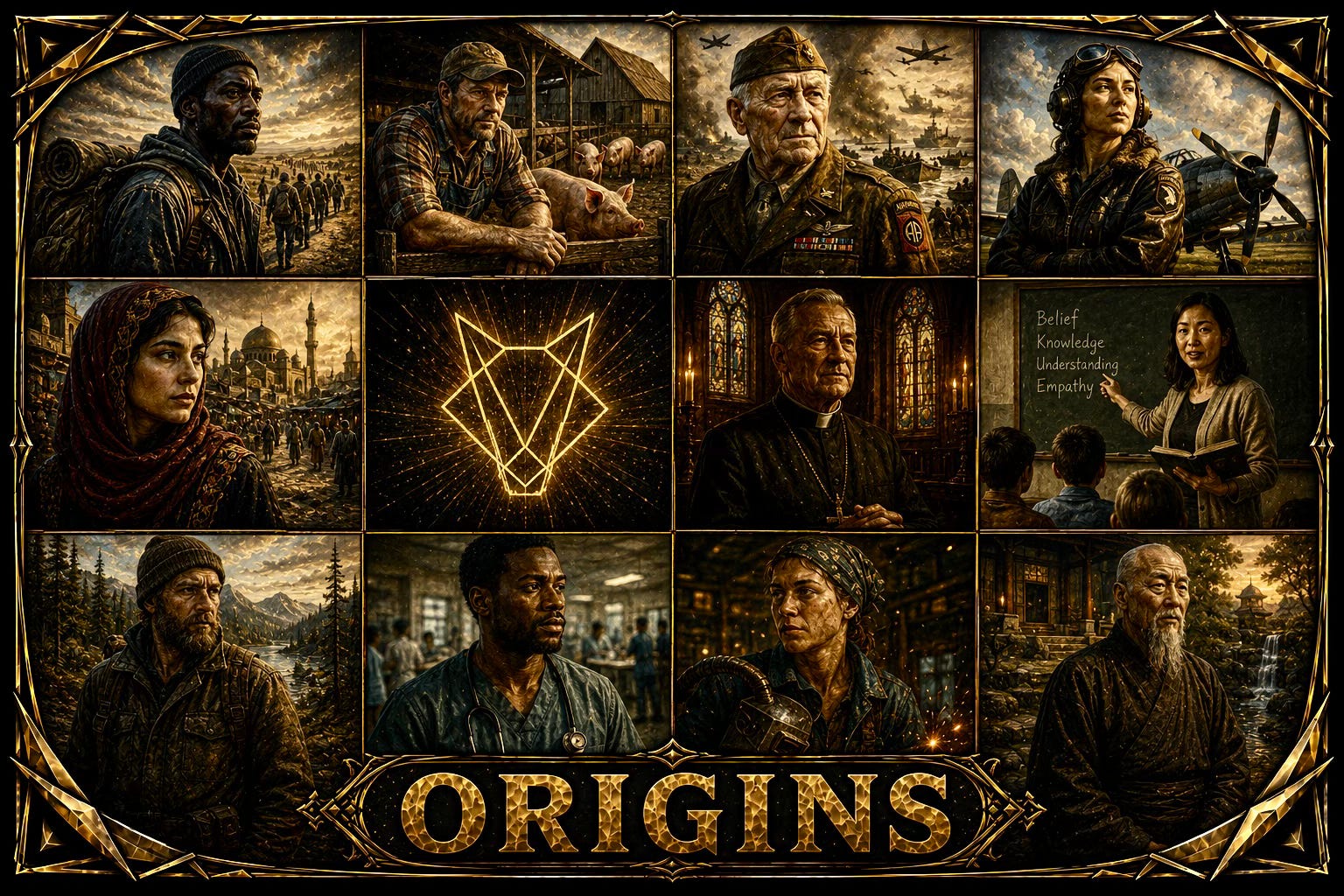
During my time in home health, I’ve gained perspectives from WWII vets that stormed Normandy Beach, Navy Seals, POW’s, and Green Berets. Those stories were just as valuable as the opera singer, the Arkansas pig farmer, or the Cherokee native. I’ve broken bread and eaten things I can’t pronounce with characters from all walks of life. African refugees, Zoroastrians, Holocaust survivors, and French Cajuns. I’ve treated the wealthy housed in mountaintop lodges, and the poorest barely surviving in abandoned RV’s. I’ve been offered sweet tea and cookies in one home, and dodged snakes and roaches in another. Some homes are empty and devoid of life, some are full of love, and others are hoarded with feces on the walls. Yet they are all people, and all characters that I continue to learn from.
When I sit down with someone long enough, especially near the later chapters of their life, the conversation often veers into the non-physical realm. It drifts, and opens up. Pain in the knee turns into a story about a lost spouse. A recent fall can turn into a quiet admission of fear, of becoming dependent, and having to leave the home they cultivated a life in. Exercises become an excuse to talk about regret, meaning, faith, or the lack of it. What I thought would be routine clinical sessions often felt more like windows into the human condition. Everyone had a backstory. And I began to notice patterns with each patient I encountered.
“The voyage of discovery is not in seeking new landscapes but in having new eyes.” - Marcel Proust
Many seemed to inhabit terrain they were unaware of. Some found their purpose early in life, while others were oblivious to the idea. There were masters of relationships, and people that excelled in burning every bridge they once knew. Some patients were trapped, wandering inside a wilderness of their own making. Yet others were placed in settings of extreme difficulty, experiencing significant loss, and still walked away more resilient. Through each interaction, a landscape began to appear that resembled an inner journey.
I originally held an assumption that the longer the journey, the more wisdom it produced. It’s what I expected from someone of old age, with a lifetime of tales and treasures. I’ve met a few people who carry a kind of grounded clarity about them, the kind you can’t fake. They are the old-souls that most don’t notice, a guiding force for those travelers privileged enough to cross their paths. But in my experience, the wise old elders are rare, and the sages live most of their lives inside the pages of fairytales.
Instead, more often I’ve seen something else. Most of us, no matter how old we get, are still children deep inside trying to figure life out. The same questions follow us: Who are we? What actually matters? What doesn’t? What does it all mean? The body ages, but that doesn’t mean the inner landscape automatically organizes itself with time. Yet, regardless of how long one’s inner-growth takes, the life experiences of my patients have revealed much more of that landscape than they may realize.
THE MISSION
After working with thousands of patients from different backgrounds, cultures, and beliefs, one pattern continues showing up. The outcomes I was seeing aren’t just tied to their physical condition. Two people can have the same surgery, same diagnosis, same plan of care, and their results will be completely different. The difference often comes down to something less visible. Their type of mindset, sense of purpose, and their ability to adapt. Their relationship to fear, pain, and uncertainty.
Wolf Rehab began at the end of 2020, at a time when the world was forced to confront its own fragility. The original concept was to outrun the wolves, a metaphor for the injuries and illnesses that catch people living a sedentary or complacent lifestyle. The idea was to transform a person into the wolf by becoming the predator of their own physical weaknesses. But it’s deeper than the simple idea of predator or prey. One lives with agency, the other reacts to threat. The way we interpret the world shapes how we move through it. A constant state of fear narrows perception. It makes everything feel like something to survive. On the other side, a sense of agency allows for planning, movement, and intention. We certainly saw this play out during the Covid era.
But at that time, I was still focused on physical recovery. It was what I was trained to do. But over time, it became clear that stopping at the body was incomplete. If people are navigating life through more than just physical structures, then real rehabilitation has to meet them there. Many of my physical therapy sessions turned into psychological and spiritual therapy. This forced me to understand these terrains better. I needed a map, and a method to cross it. A bridge.
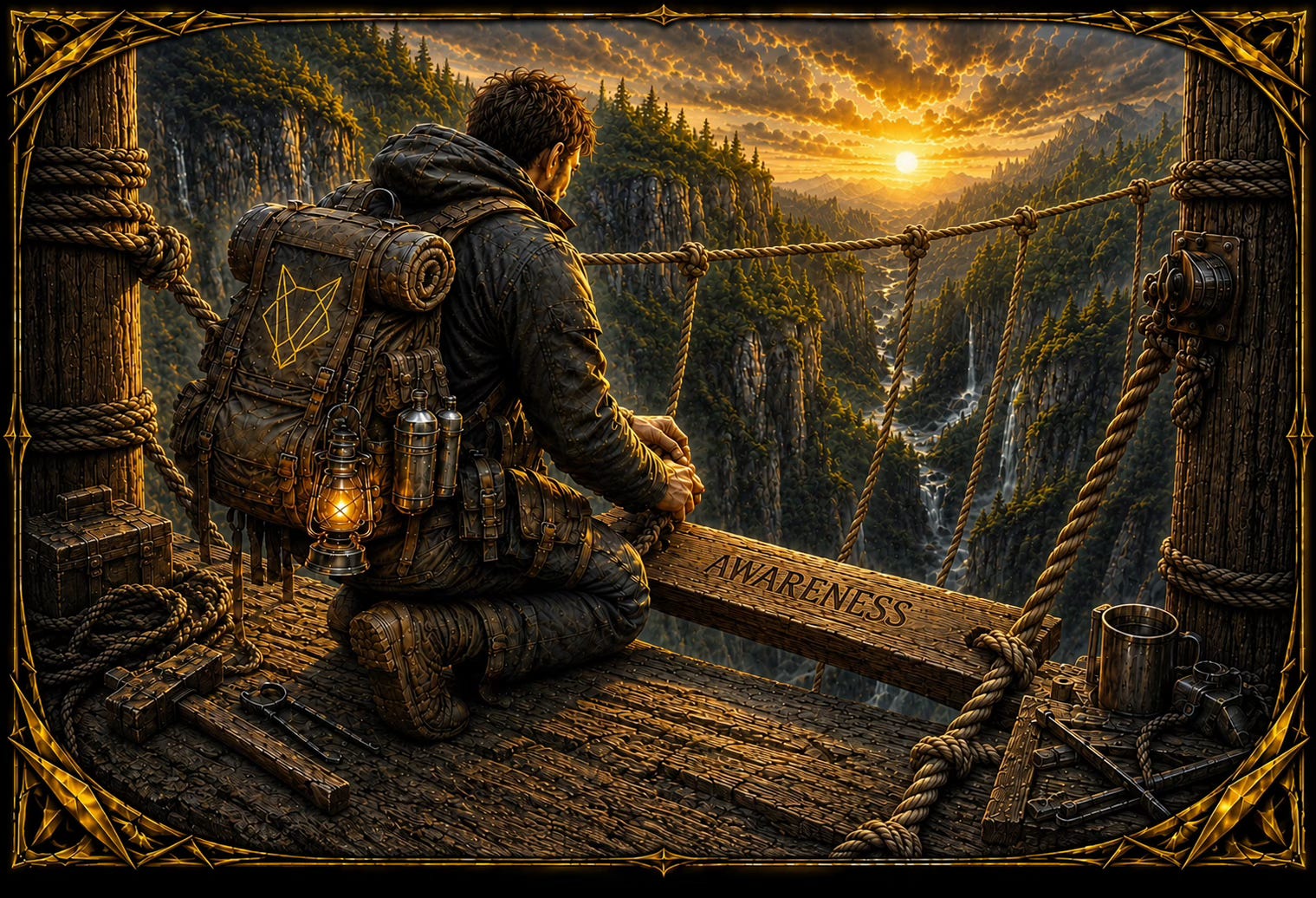
Over the years, I’ve continued building my awareness in areas that help bridge the gap of my own ignorance. This has been useful in surveying my inner landscape, and identifying where others reside in theirs. This constant method has aided my ability to meet strangers, and help them cross the barriers that obstruct their path. In this process, I’ve realized that other people might benefit from building bridges of their own.
Therefore, I decided to expand Wolf Rehab into something broader. This will be a space to explore, test, and question ideas, and build something useful out of them. It seems that most of us are walking through terrain we don’t know how to read. For example, I was completely unprepared to encounter Willie. I didn’t have the tools needed to comprehend the complicated relationships surrounding our little old lady. In a way, I feel like I failed her by retreating from the problem, unable to discern how to help her. But I also crossed a threshold that foggy morning. That first home health visit confirmed my path, aroused my curiosity, and revealed the possible adventures that await behind a stained blanket stapled to the wall.
Whether we are attempting to help others, or just residing in our own domain, we can now create a type of working field guide to navigate all the terrain that lies ahead. So think of this as a map in progress. A bridge being built plank by plank. Each idea, each topic, and each question becomes part of the structure. The goal isn’t to tell anyone what to think. It’s also not me pretending that I have all the answers. It’s an adventurous journey of self discovery. It’s an attempt to see into the landscape more clearly so we can move through it with intention, and build our own bridges of transformation.
“Over the river and through the woods, to the mountain tops we go!!!” - Me, that was my quote.
BRIDGING THE GAP
Can you remember a moment when an experience challenged something you had always assumed was true? What happened, and how did it affect the way you see the world today?
What beliefs, ideas, or explanations did you inherit from your family, culture, education, or community that you have since reexamined? What prompted you to look at them differently?
Looking back on your life, were there certain people, books, events, or hardships that seemed to act as catalysts for expanding your perspective? Why do those moments stand out?
Is there an area of your life right now where you feel curiosity pulling against certainty? What questions are you reluctant to ask, and what might happen if you explored them honestly?
Working in home health has a way of clarifying what actually matters. When you’re sitting with someone near the end of their life, the metrics change. No one talks about how many subscribers they had as the curtains close. The conversation narrows to relationships, and the people they loved. They speak of people they wish they had more time with, and the moments that carried weight. That perspective has a way of cutting through the noise. To live everyday as your last, and to build things that transcend time.
Wolf Rehab is about creating something that has value. If it helps even one person see their situation more clearly, make a better decision, or feel less alone in the process, then it’s done its job. If you feel this project is worth sharing with someone, then please do so. We appreciate every one of you.
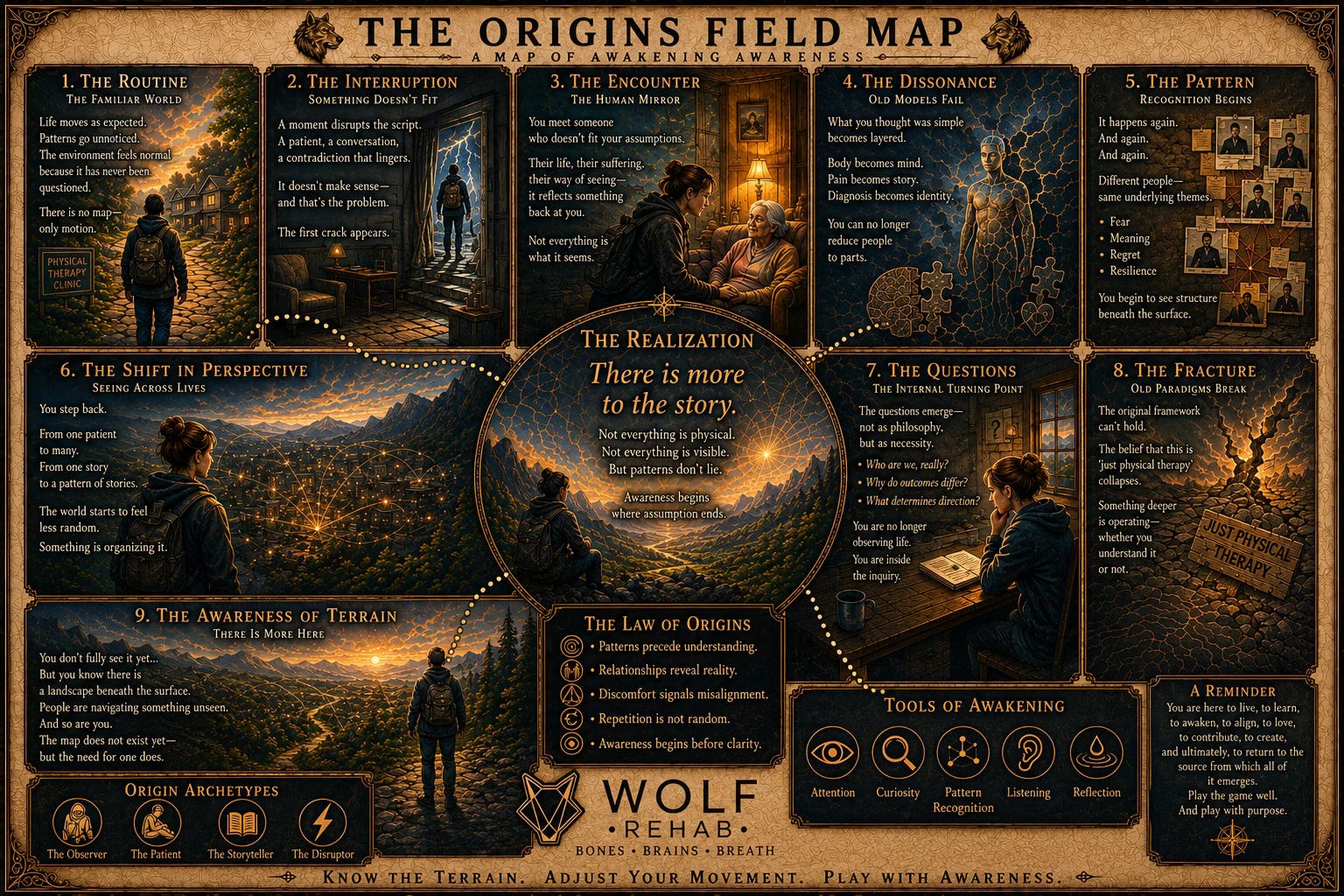
For those who choose to walk this path with us, the next step is to understand the structure we’re building. Because before you cross a bridge, it helps to know what it’s made of, and the reality of the terrain you are crossing.
Here is your ORIGINS Field Map:
Wolf Rehab, LLC is a registered trademark. All rights reserved.
Willie… Wow.