
INTERFACE
Understanding how we perceive reality, and the differences between experiences

Welcome to Wolf Rehab. We are in the process of building a field guide for the human experience, investigating the terrain we call life, developing a method to traverse it, and building bridges that enable us to cross thresholds into higher levels of awareness and transformation.
So far we have described reality as a LANDSCAPE that is layered, and something we move through rather than stand outside of. The BRIDGE showed that across cultures, people have tried to make sense of that movement by building symbolic structures that help them cross from one state of being into another.
Now we arrive at something that has been present the entire time, but unexamined by most. The INTERFACE.
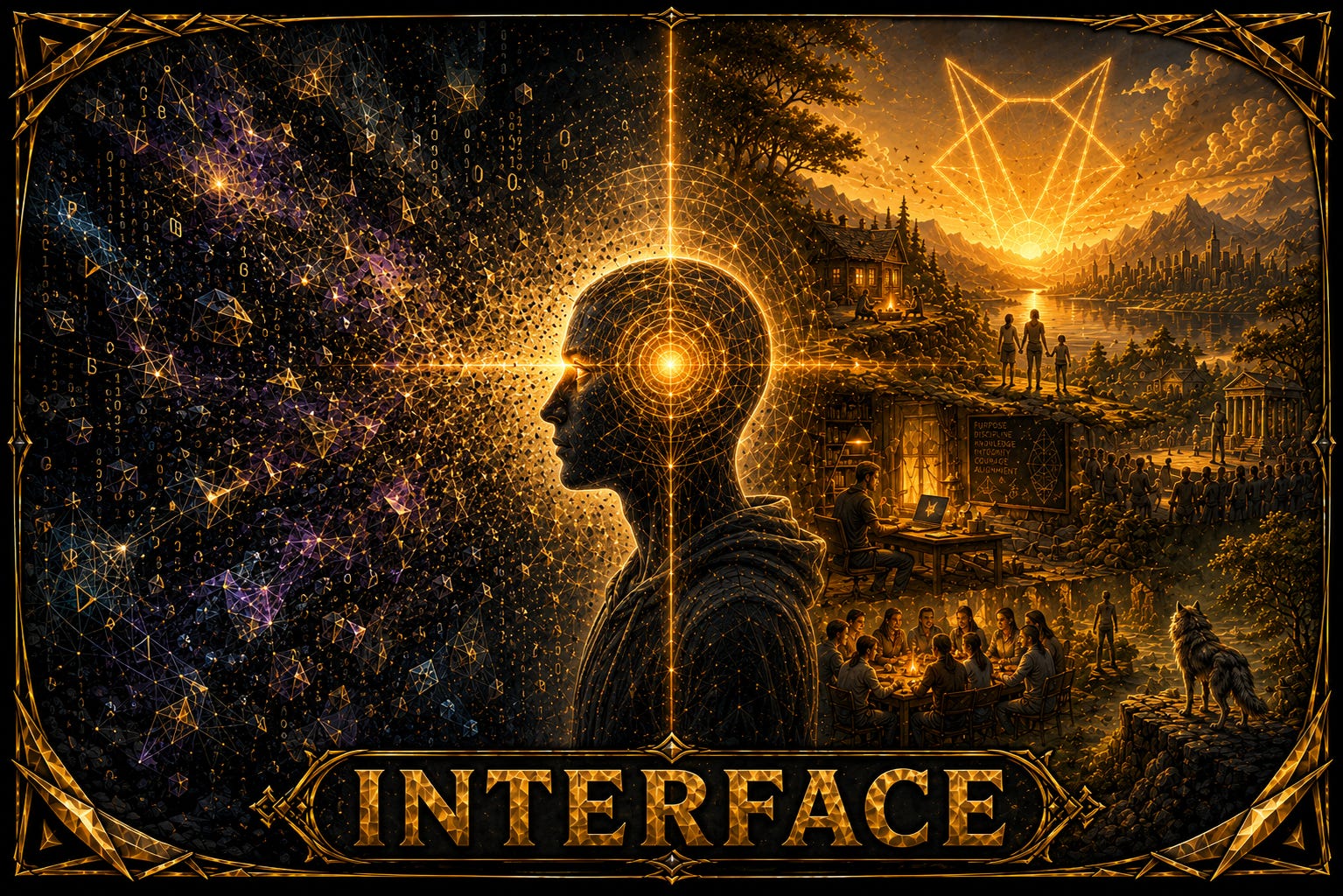
Growing up in our old farmhouse, we didn’t have the luxury of cable television like some of my friends. We instead had a thousand pound wooden box with a small screen built into it. The only method of reception was a pair of rabbit ear antenna with tin foil wrapped around the ends. Positioning the tin foil perfectly to maintain a clear signal for the five channels we had available required a master’s degree in electrical engineering. During thunderstorms or windy days, us kids would have to take turns being the antenna. We’d sacrifice ourselves on a Friday night to watch the sitcom lineup, holding the rabbit ears manually to improve the interface.
The screen, the dials, and the antenna were all outdated and failing. It affected the clarity and the experience of what we could perceive through the screen. When watching NFL football games on a Sunday afternoons, I’d have to rely on the announcers to articulate what was taking place on the field. The screen was so grainy, that following the football was nearly impossible. Was it a run, a pass, or a fumble? My father would wake up from the recliner when one team scored, and somehow recall the plays leading up to the touchdown. It was a skill I can only attribute to a well tuned interface that didn’t require being awake. Looking back, our TV did a horrible job interpreting reality, but it did create memories that I can laugh at now.
An interface can be understood as a point of interaction between two things. In technology, it’s the layer that allows a user to engage with a complex system without needing to understand all of its underlying code: the screen, a dashboard, a control panel. These don’t show you everything that is happening behind the scenes. They present just enough, in a usable form, so that you can operate within the system.
Human perception works in a similar way. The body gathers information through the senses. The brain processes that information using patterns built from past experience. Attention selects what becomes clear, and everything else fades into the background. What we call “reality” is the result of that entire process working together. It is not a direct feed. It is a constructed experience that allows us to function within a much more complex environment.
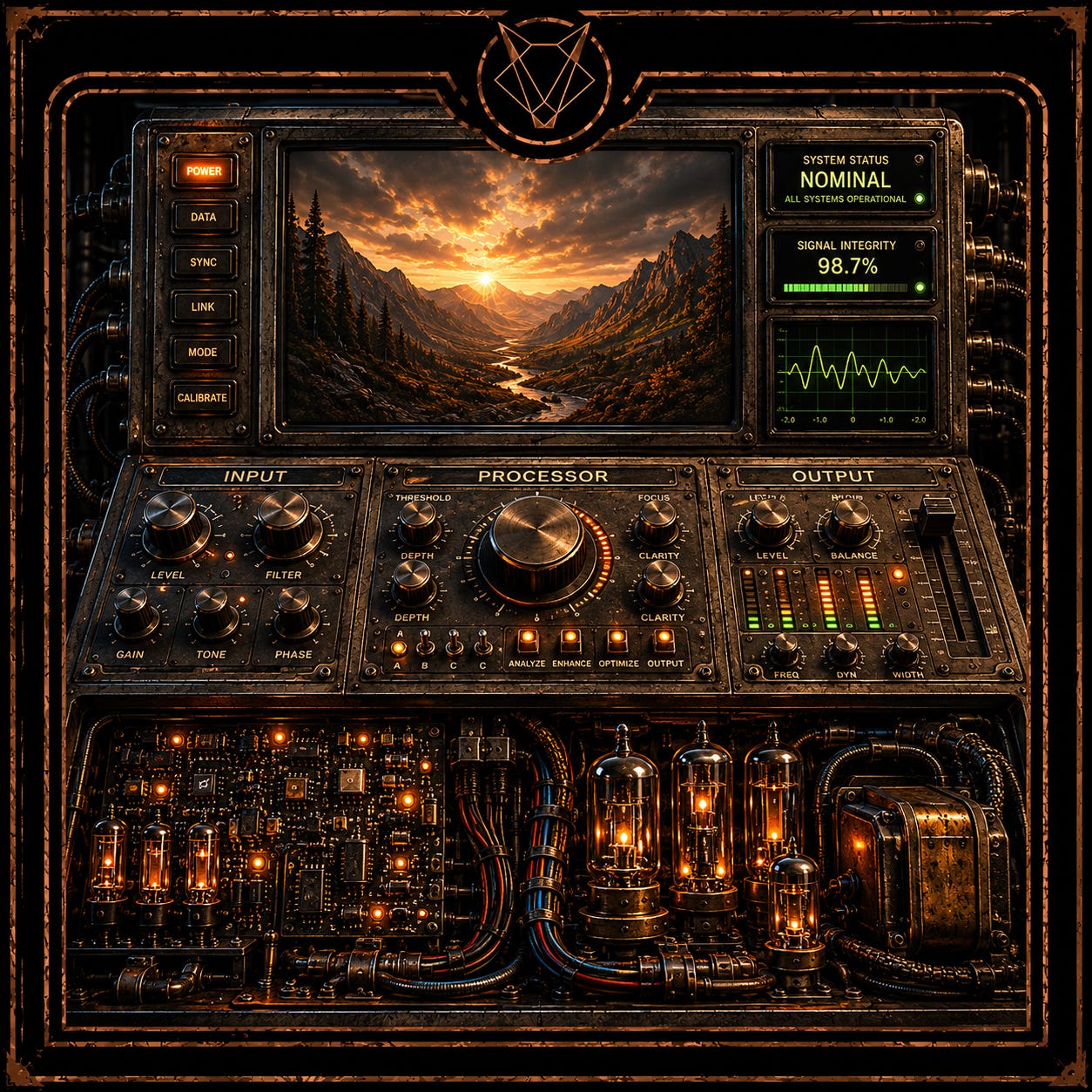
Neuroscience gives us a clearer sense of just how selective that construction is. At any given moment, the human sensory system is receiving an enormous amount of data. Estimates often place the total input in the millions of bits per second when accounting for visual, auditory, tactile, and internal signals. Functioning would be impossible if we were aware of each one. Our consciousness is capable of processing only tens of bits per second. The exact number varies depending on how it is measured. The implication is that an overwhelming majority of incoming information is filtered out before it ever reaches awareness. So what we experience is only a tiny fraction of what we call reality.
This becomes easier to recognize when we look at how inconsistent experience can be across people. This is evident with polarizing issues such as politics, religion, and social issues such as sexual orientation and abortion. Two individuals can move through the same environment and come away with entirely different impressions. One notices details that the other never registers. One feels at ease while the other feels tension. There is a reason these differences occur. They reflect how each person’s interface is tuned, what it prioritizes, and what it filters out.
For example, one person watches Fox News and tunes in to the pundits aligned politically to the right. This strengthens their interface in a particular direction, picking up stronger signals they agree with, and noticing more patterns that align with their belief of reality. This is known as confirmation bias. A different person tunes in to MSNBC and gets fed a point of view that comes from the political left. That person cannot understand how their version of reality is not understood by the “other”. If both people try to persuade on another with actual facts that don’t register with their interface, we call it cognitive dissonance. In that case there is no tin foil on the antenna, and the screen glitches with static. Both people are quite literally living in two separate realities.
The brain plays a central role in regulating this interface. There are networks that help determine what becomes part of conscious awareness and what stays beneath it. One of the more studied systems is the Default Mode Network, which is active when the mind is not focused on a specific external task. It’s involved in self-referential thinking. This determines our sense of identity, our internal narrative, and our tendency to replay the past or imagine the future.
When this network is highly active, experience tends to be filtered through personal story. Everything becomes connected to “me.” My past, my concerns, my expectations. When it quiets, as it can during certain forms of meditation or deep concentration, people often report a shift. The sense of separation softens. Experience feels more immediate and less interpreted. This is often expressed as living in the “Now.”
Other systems work alongside it. The Salience Network helps determine what is important enough to pay attention to. The Executive Control Network helps direct focus and manage behavior. They are all part of the machinery that decides, moment by moment, what enters your awareness and what does not.
A practical way to see this in action is through something known as the Baader-Meinhof phenomenon. If you decide to buy a specific type of car, you will start noticing that same model everywhere on the road. It feels as if the number of those cars has suddenly increased, but what has actually changed is your attention. The interface has marked that object as relevant, and now it stands out against the background.

The same mechanism applies far beyond cars. It shapes what opportunities we notice, what risks we perceive, and even how we interpret other people’s behavior. If we keep our attention tuned to negative outcomes, then that is all we will notice. The power of positive thinking has a real benefit, and it has everything to do with what a person chooses to give their attention to. The landscape hasn’t changed. The interface has shifted what it highlights.
Time is another area where the interface becomes visible. Under normal conditions, time feels steady and predictable. But in certain states, that perception changes.
When someone enters a flow state, where attention is fully absorbed in a task that is both challenging and manageable, time often feels compressed. Hours can pass with little awareness of their duration. This happens because the brain reduces activity in areas associated with self-monitoring and narrative tracking. With less attention directed toward the passage of time and more directed toward the task itself, the experience of time shifts.
In contrast, during moments of stress or discomfort, time can feel stretched. Attention becomes fragmented, often pulled between the present moment and anticipation of what might happen next. The interface is no longer streamlined. It is overloaded with competing signals, and the experience reflects that. A stressful day can seem to last forever.
Memory also reveals how the interface operates. It’s common to think of memory as a storage system, but it functions more like a reconstruction process. Each time a memory is recalled, it is influenced by the current emotional state and context. Over time, details can change. It’s not because someone is intentionally altering them, but because the interface is continuously reassembling the experience. If I still had the same TV today as I did in my youth, I can assure you I wouldn’t be laughing at the memory.
This has practical implications in areas like therapy. Approaches used to treat trauma, including certain forms of cognitive behavioral therapy and EMDR (Eye Movement Desensitization and Reprocessing), work in part by helping individuals revisit and reprocess difficult memories in a controlled way. The goal is not to erase the past, but to change how it is experienced in the present. By altering the emotional and cognitive associations tied to a memory, the interface presents it differently. The event remains, but its impact can shift significantly.
If the interface is what determines how reality is presented, then it follows that when the interface becomes unstable, reality itself can feel unstable. This becomes more apparent when we look at conditions where perception and interpretation are significantly disrupted. A great example of this is schizophrenia.
If you read the Origins essay, then you will remember me recalling the story of Willie. He was a morbidly obese man with schizophrenia whose interface was broken. His interpretation of reality included a miniature girlfriend who lived in the refrigerator. He lived a very dysfunctional and paranoid life because he couldn’t trust the signals he was receiving.
Schizophrenia is often described in terms of hallucinations or delusions, but from an interface perspective, it can be understood as a breakdown in the system that distinguishes internally generated signals from externally sourced ones. Thoughts that would normally be recognized as one’s own may be experienced as coming from outside. Patterns that would normally be filtered out as noise may be interpreted as meaningful. In this case, the interface is misclassifying incoming data.

This is most visible when witnessing homeless individuals appearing to have conversations with themselves. I see this on a daily basis when driving into the city. There are many reasons for homelessness, but the vast majority of people living on the streets have mental illnesses or drug addictions. Many are schizophrenic, having animated arguments with invisible people. This is not a matter of someone seeing something that isn’t there. The sensory data may be present, but the interpretation layer is altered. The boundary between internal narrative and external reality becomes less defined. What is usually a stable distinction of “this is a thought”, and “that is the world” begins to blur.
When viewed this way, schizophrenia is one of many revealing examples of how the interface works. It shows that what we experience as reality depends heavily on the stability and calibration of the interface. When that calibration shifts, even slightly, the world that appears can change dramatically.
This same principle takes shape, in a more controlled way, in the use of plant-based psychoactive substances. Certain compounds, such as DMT or psilocybin, are known to significantly alter patterns of brain activity. This is particularly seen within the default mode network. Under their influence, the usual filtering and prioritization systems loosen. Signals that are typically suppressed may enter awareness. The sense of self, normally maintained through consistent narrative processing, can temporarily dissolve or reorganize.
“Think of the brain as a hill covered in snow, and thoughts as sleds gliding down that hill… In time, it becomes more and more difficult to glide down the hill on any other path. Think of psychedelics as temporarily flattening the snow. The deeply worn trails disappear, and suddenly the sled can go in other directions, exploring new landscapes and, literally, creating new pathways.” - Mendel Kaelen (neuroscientist at Imperial College London)
In this context, people often describe the experience as if the interface has been “reset” or “opened.”
But that opening is not inherently stable. Integration is the process of reflecting on and incorporating the experience afterward. Without it the system can remain disorganized. Insights may be intense but fragmented. Perception may feel expanded, but not necessarily grounded. This is why structured integration is emphasized in therapeutic contexts. The goal is to reorganize the interface in a way that allows for more coherent interaction with reality.
When the interface becomes rigid, as in the case of addiction, it can get locked into repetitive patterns of thought, perception, and emotional responses. Plant “medicine” in the form of psychoactive compounds can disrupt these patterns and create space. But the long-term value depends on how that space is navigated afterward.
This ability to observe and work with the interface is not a new discovery.
The Stoics, writing over two thousand years ago, developed a framework that closely aligns with this idea. They made a distinction between events and the judgments we place on them. An external event occurs, but the emotional response is shaped by how that event is interpreted.
Some people confuse Stoicism with suppression of emotion, but it is more accurately the practice of learning to see the interpretation process clearly. Emotion is still present, but the aim is to respond to situations with greater clarity and less reactivity. In modern terms, you could say Stoics were training themselves to recognize the interface at work. They understood that while they could not control everything that happened in the landscape, they could influence how it was processed and experienced.
All of this brings us back to the broader structure we’ve been building.
The Landscape represents the environment, both external and internal, that we move through. The Bridge represents the methods, practices, and insights that help us navigate that environment. The Interface is the system that allows any of it to be experienced at all. It determines what is noticed, how it is interpreted, and what meaning is assigned.
Our ability to interact with the interface can literally change our life. The ability to tune our attention in a particular direction, or hold the metaphorical tin foil on the antenna for a clearer signal, can present us with new versions of reality. Changing the channel dial, and accessing new information can begin shifting perception and altering our steps in new directions. Once that becomes clear, a more precise question begins to form. If the interface is selecting, filtering, and presenting experience, then who is it presenting that experience to?
We can observe thoughts, which means there is some level of awareness separate from them. We can notice shifts in attention, which suggests that attention itself is being directed. We can reflect on our own identity, which raises the question of what is doing the reflecting.
Understanding the interface doesn’t answer those questions completely. It does something more important. It shows that what we experience as reality is not the source. It is the display. The interface is the layer that makes the terrain visible, and that gives it texture, shape, and meaning. It is what allows us to move, decide, and act. But like any interface, it is not the system itself. And it is not the one using it. The next step is to look more closely at the one who is looking through the screen: The Player.

BRIDGING THE GAP
Have you ever discovered that a situation was very different from how you initially perceived it? What influenced your original interpretation, and what changed?
What habits, beliefs, emotions, or identities most strongly shape the way you interpretation the world around your? How might your experience differ if those filters were absent?
Think about two people who experienced the same event but reached completely different conclusions. What does that reveal about the role perception plays in constructing reality?
If your thoughts, emotions, memories, and beliefs are all part of the interface through which you experience life, who or what is the one observing the interface itself?
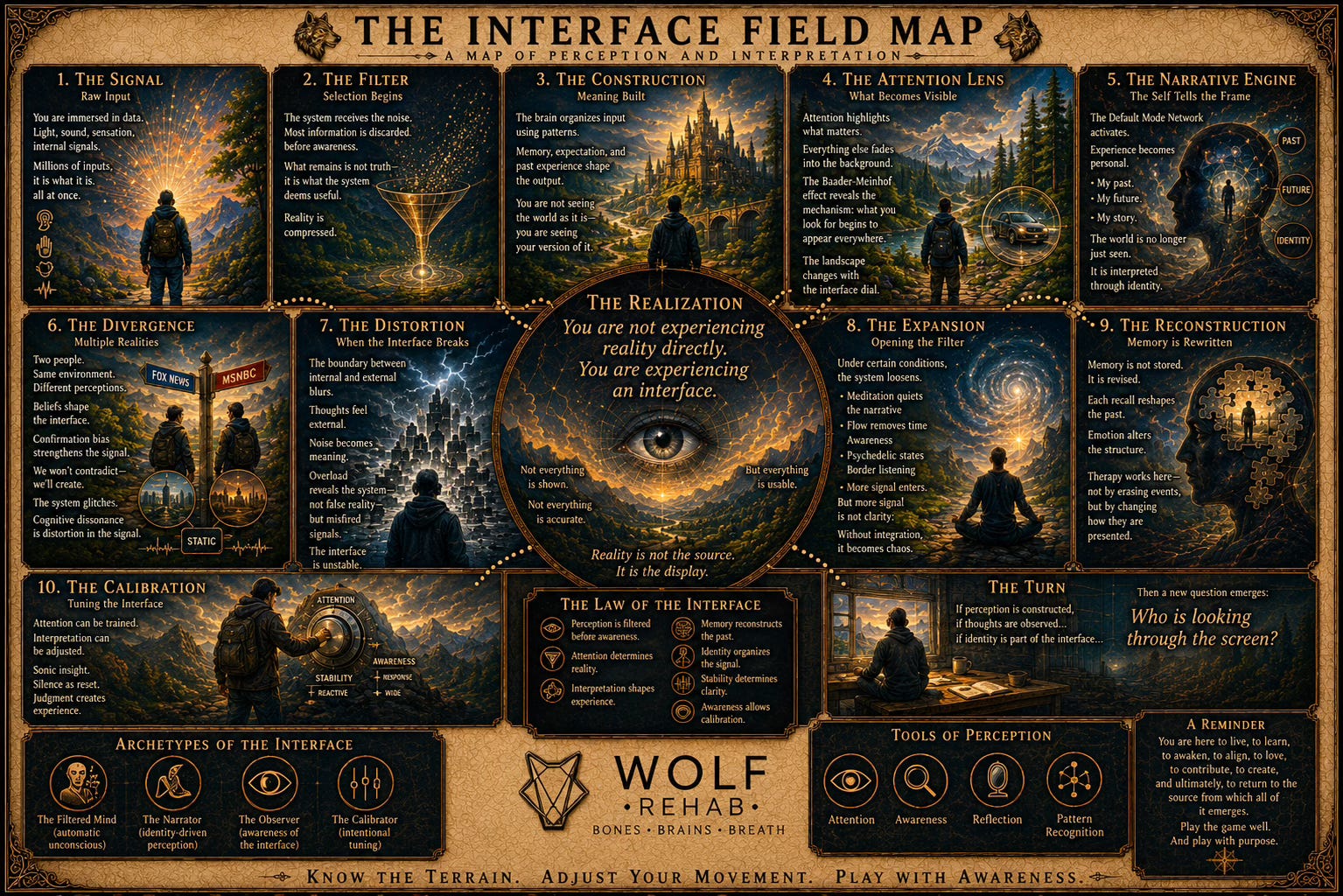
Below is your INTERFACE Field Map:
Wolf Rehab, LLC is a registered trademark. All rights reserved.
As I’ve heard say, Stoicism isn’t the supression of emtion but the domestication of emotion.